
Football looks simple at first glance, but once you start watching closely, the questions stack up. Why was that goal disallowed? Why did the referee blow for offside when no one looked offside? Why do some free kicks have walls and others don’t?
Every question has a clear answer. Football is governed by 17 official Laws, written and maintained by the International Football Association Board, known as IFAB, since 1886. The Laws cover everything that can happen during a match, from how a goal counts to how a substitution works.
This guide walks through football rules and regulations in plain language. You will learn how a match works, how teams score, and why offside exists. It also covers fouls and cards, set pieces, and how major competitions are structured.
The Basics: Players, Pitch, and Match Duration
A football match runs between two teams of 11 players each. One player per side is the goalkeeper. The goalkeeper alone can handle the ball, and only inside their own penalty area. Goalkeepers may hold the ball for up to eight seconds before releasing it, otherwise the opposing team takes a corner kick.
A regulation match lasts 90 minutes, split into two halves of 45 minutes each. The referee adds time at the end of each half to account for stoppages. This added time often decides matches.
In knockout competitions, level scores after 90 minutes go to 30 minutes of extra time. If the tie remains level, a penalty shootout settles it.
Substitutions vary by competition. Premier League teams may make five substitutions per match, and five substitutes may warm up at the same time. Most managers spread those into three substitution windows so play does not stop constantly.
How the Football Scoring System Works
The football scoring system is the simplest in major team sport. A goal counts when the entire ball crosses the goal line between the goalposts and beneath the crossbar. One goal equals one point. The team with more goals at the end of the match wins.
That is the entire scoring system. No field goals, no half-points, no bonus values for distance. The simplicity is part of why football travels so well across cultures.
In league competitions, teams earn three points for a win, one for a draw, and zero for a loss. The club with the most points at the end of the season finishes first.
The Offside Rule Explained
The offside rule is the single most debated law in football. It exists for one reason. Without it, attackers could simply wait near the opposition goal for an easy tap-in, and the game would lose its tactical depth.
Here is what Law 11 actually says. A player is in an offside position if two conditions are both met. First, any part of their head, body, or feet sits in the opponents’ half. Second, that body part is closer to the opponents’ goal line than both the ball and the second-last opponent. The hands and arms do not count.
In plain terms: an attacker is offside if, when a teammate plays the ball, they are in the opponents’ half and beyond the second-to-last defender.
But here is the key. Being in an offside position is not itself an offence. The offence only occurs when a player in that position becomes involved in active play. That means touching the ball passed by a teammate, interfering with an opponent, or gaining an advantage from the position.
There are also clear exceptions. A player cannot be offside when receiving the ball directly from a goal kick, a throw-in, or a corner kick.
An offside offence results in an indirect free kick to the defending team, taken from the spot of the offence.
At the top level, Semi-Automated Offside Technology (SAOT) supports the on-field referee. It uses cameras and ball-tracking to draw automated offside lines, accurate to the width of a shoulder.
Fouls, Yellow Cards, and Red Cards
Law 12 governs fouls and misconduct. Most fouls fall into common categories: tripping, pushing, charging carelessly, handling the ball deliberately, or making a reckless challenge. Most fouls result in a free kick. A foul committed inside the offending team’s own penalty area results in a penalty kick.
Referees enforce discipline through yellow and red cards. A yellow card is a formal caution. Two yellow cards in the same match equal a red, and the referee sends the player off. Direct red cards follow serious offences: violent conduct, serious foul play, or denying a clear goalscoring opportunity through a foul.
When a player gets sent off, the team finishes the match with one fewer player. They cannot bring on a replacement.
Only the team captain may approach the referee for explanation of major decisions. Other players who do so risk a yellow card for dissent. If the captain is a goalkeeper, the team must nominate an outfield player before kick-off.
Major competitions also use the Video Assistant Referee, known as VAR. The system reviews four categories of decisions: goals, penalty decisions, direct red cards, and cases of mistaken identity. The on-field referee retains final authority and reviews footage at a pitchside monitor before deciding.
Set Pieces and Restarts
When play stops, the game restarts in one of several specific ways. The choice is rarely incidental: it tells defenders where to position and attackers where to attack.
| Restart | When It Is Used |
|---|---|
| Throw-in | When the ball fully crosses the touchline |
| Goal kick | When the attacking team last touched a ball that crossed the defending goal line outside the goal |
| Corner kick | When the defending team last touched a ball that crossed their own goal line outside the goal |
| Direct free kick | After most fouls. The ball can go straight into the goal |
| Indirect free kick | After certain technical offences. The ball must touch another player before counting |
| Penalty kick | After a direct-free-kick foul committed inside the penalty area |
| Drop ball | When play is stopped for a reason not covered by another restart |
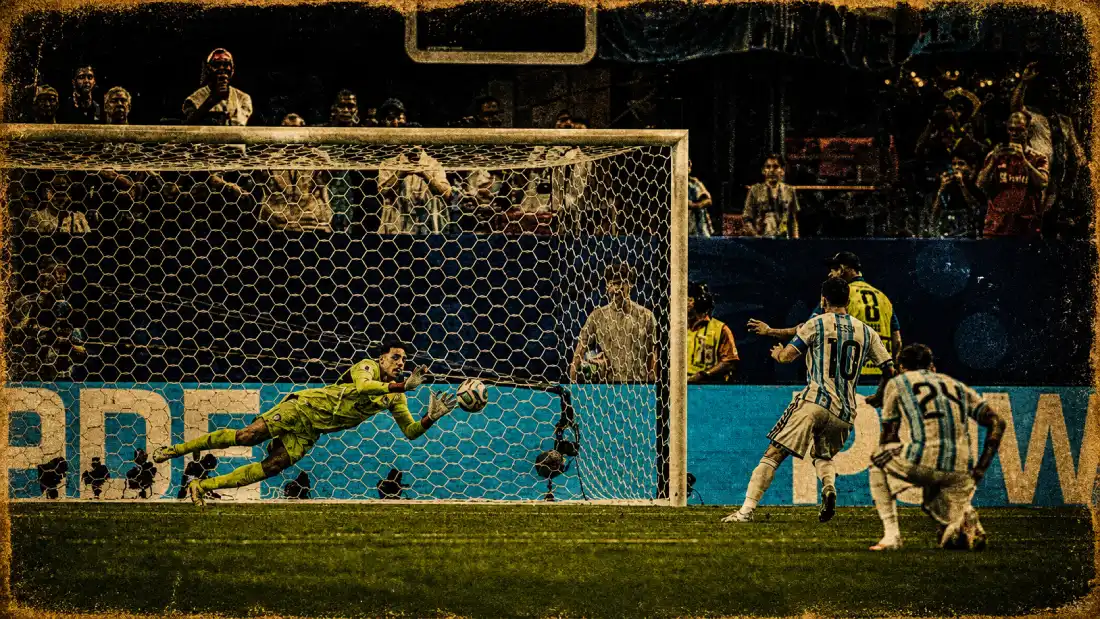
Penalty kicks come from twelve yards out, with only the goalkeeper between the kicker and the goal.
How Football Competitions Are Structured
Football competitions follow two main formats: league and knockout. The biggest events combine elements of both.
Domestic Leagues
A league season operates on a round-robin basis. Each team plays every other team home and away, typically over a nine-month season. The Premier League runs 20 clubs over 38 matches per team. The team finishing first wins the title. The bottom clubs drop down to the division below, while clubs from the second tier earn promotion up. Between seasons, squads reshape through football transfers, loans, and contract renewals.
Top Leagues by Continent
Every continent has its own football pyramid, with one or two leagues sitting at the top. Europe’s “Big Five” leagues are the Premier League, La Liga, Serie A, the Bundesliga, and Ligue 1. They carry the largest global audience and the most broadcast revenue in the sport.
| Confederation | Region | Top Leagues |
|---|---|---|
| UEFA | Europe | Premier League (England), La Liga (Spain), Serie A (Italy), Bundesliga (Germany), Ligue 1 (France) |
| CONMEBOL | South America | Brasileirão (Brazil), Liga Profesional (Argentina) |
| CONCACAF | North & Central America | Major League Soccer (USA/Canada), Liga MX (Mexico) |
| AFC | Asia | Saudi Pro League, J1 League (Japan), K League 1 (South Korea) |
| CAF | Africa | Egyptian Premier League, Botola Pro (Morocco), Ligue Professionnelle 1 (Tunisia), Premier Soccer League (South Africa) |
| OFC | Oceania | New Zealand National League (Australia’s A-League Men plays under the AFC) |
Knockout Competitions
Knockout competitions, such as the FA Cup, work on a straight elimination basis. Win and you advance. Lose and you are out. Ties level after 90 minutes go to extra time, then penalties.
The latter rounds of the UEFA Champions League use the same knockout format after the league phase. The same applies to the UEFA Europa League and Conference League knockouts.
International Football
International football runs on a four-year cycle. The FIFA World Cup is the pinnacle, and performances shape the World Cup rankings that decide seeding for future tournaments. The European Championship, Copa América, and Africa Cup of Nations are the major continental events. Qualification is a multi-year process of home-and-away matches.
The Major Football Competitions at a Glance
| Competition | Confederation | Type | Frequency |
|---|---|---|---|
| FIFA World Cup | FIFA | National teams | Every 4 years |
| UEFA European Championship | UEFA | National teams | Every 4 years |
| Copa América | CONMEBOL | National teams | Every 4 years |
| Africa Cup of Nations | CAF | National teams | Every 2 years |
| AFC Asian Cup | AFC | National teams | Every 4 years |
| CONCACAF Gold Cup | CONCACAF | National teams | Every 2 years |
| UEFA Champions League | UEFA | Club | Annual |
| UEFA Europa League | UEFA | Club | Annual |
| Copa Libertadores | CONMEBOL | Club | Annual |
| AFC Champions League Elite | AFC | Club | Annual |
| CAF Champions League | CAF | Club | Annual |
| CONCACAF Champions Cup | CONCACAF | Club | Annual |
| FIFA Club World Cup | FIFA | Club | Every 4 years |
Why the Rules Matter
Football’s rule book is a living document. IFAB meets annually to weigh proposals from FIFA and member associations. The reasons for change vary: player safety, closing tactical loopholes, or keeping the game watchable as technology evolves.
Every law in the book exists for a reason. Offside protects the geometry of attack and defence. Cards protect players from violent conduct. Set pieces give the game its restart points. Understand the Laws, and you understand the game.