Every five years or so, soccer gives us a figure so aggressively uncompromising, so deeply weird, and so utterly mesmerizing that the entire sporting ecosystem loses its collective mind.
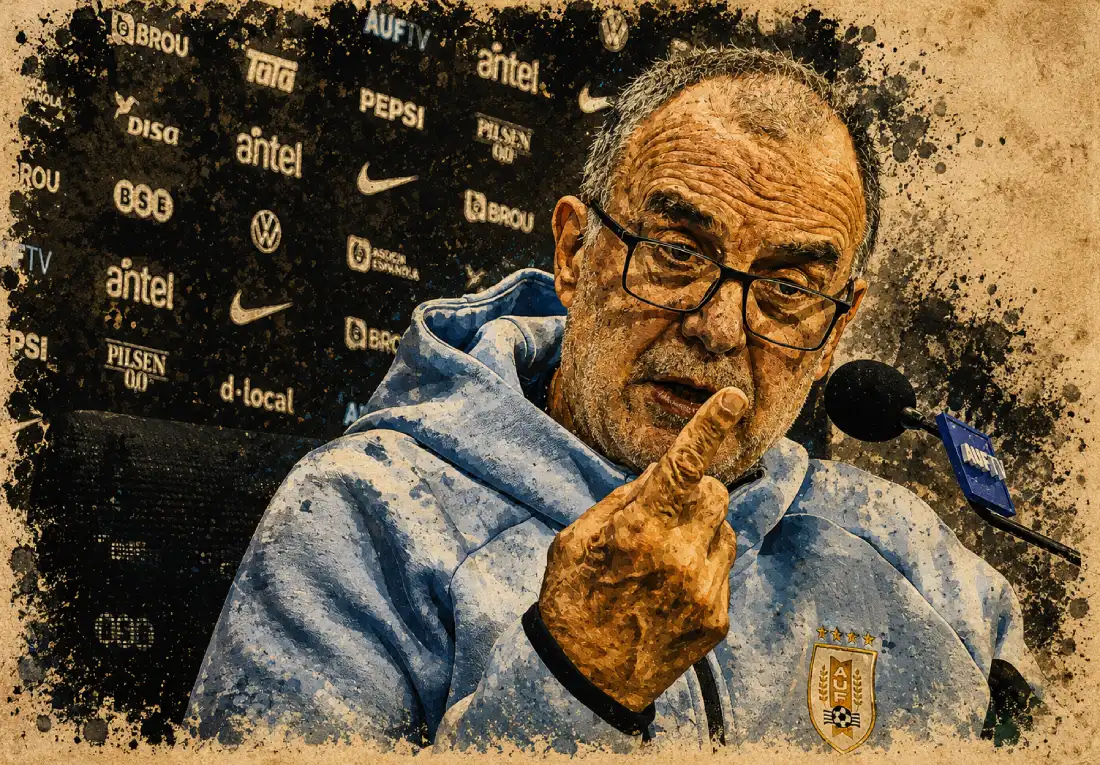
Enter Marcelo Bielsa. El Loco.
If you tracked the “Bielsa Hype Index” from roughly 2018 to 2021, it was hitting peak 1999-Keanu-Reeves-post-Matrix levels. He took Leeds United—a historically proud but deeply broken franchise buried in the English second tier—and turned them into a walking, breathing, high-intensity art installation. They played a style of soccer that looked like 11 guys who had just consumed four Red Bulls each, sprinting across the pitch in a frantic, terrifying man-marking system. It was intoxicating. It shouldn’t have worked. It defied the laws of modern soccer physics.
And then, just like that, the rubber band snapped. It always does.
So, what actually happened to Bielsa? Where did the magic go? Let’s break down the three distinct chapters of the Bielsa experience, why the crash was entirely predictable, and how he just ran headfirst into the ultimate World Cup reality check.
Phase 1: The “Honey, We Bought a Cult” Era
To understand why Bielsa matters, you have to understand the sheer absurdity of his methodology. This isn’t a guy who just draws up plays on a whiteboard. He lives in a state of permanent existential crisis about space and tactical geometry.
When he arrived at Leeds, he immediately made the players pick up litter around the stadium for three hours just so they understood how hard the average working fan had to labor to buy a ticket. He famously sat on an upside-down blue bucket on the sidelines because the dugout view wasn’t analytically optimal.
He forced a grueling, twice-a-day training regimen that featured “Murderball”—a non-stop, referee-free scrimmage where the ball never leaves play. If it goes out, a coach throws another one in immediately. You don’t breathe. You just run.
For three seasons, it was a sports movie script. Leeds won promotion, climbed to 9th in the English Premier League, and became every American casual’s favorite “I stay up at 7:30 AM on a Saturday to watch this” team. Pep Guardiola called him the best coach in the world. Mauricio Pochettino worshipped him. He was the hipster king of football.
Phase 2: The Law of Diminishing Returns (The “Burnout” Equation)
Here is the dirty little secret about Bielsa’s system: it comes with an expiration date clearly stamped on the bottom of the tin.
In the NBA, we talk about coaches who have a “three-year shelf life.” Think Tom Thibodeau. Thibs comes into a franchise, yells until his vocal cords melt, plays his starters 42 minutes a night in November, gets a massive defensive jump, and then—by year four—everyone’s knees give out, the locker room mutinies, and the whole thing dissolves.
Bielsa is Thibs on an apex-predator level.
By the winter of 2021, the wheels didn’t just come off the Leeds machine; they melted into liquid iron. His refusal to compromise was his greatest asset, but it became his fatal flaw. Modern sports science tells you to manage loads, rotate your squad, and adapt when opponents figure you out. Bielsa’s response to a 4-0 loss? We didn’t run hard enough. Let’s do Murderball twice tomorrow.
The injury list grew longer than a CVS receipt. Core guys like Kalvin Phillips and Patrick Bamford were perpetually broken. Teams realized that if you just bypassed Leeds’ frantic press with long diagonal balls, you could walk into their penalty box completely unmarked. Leeds conceded 20 goals in a single month. It looked less like tactical genius and more like a human experiment gone wrong.
When Leeds finally fired him in February 2022, the fans were crying in the streets. They still loved him. It was a classic “I can fix him” relationship, long after the house had burned down.
Phase 3: The Blue Sharks Reality Check
So, where is he now? If you thought Bielsa retired to an analytical bunker to watch tape of third-division French games until his eyes bled, you don’t know El Loco. In 2023, he took over the Uruguay National Team. The football world collectively whispered, “Oh, this is going to be magnificent or catastrophic.”
For a while, it was magnificent. He phased out old-school icons like Luis Suárez, handed the keys to hyper-athletes like Federico Valverde and Darwin Núñez, and ran Argentina completely off the pitch in qualifiers. It felt like the perfect loophole: international football doesn’t give players enough time under his thumb to completely burn out. All of the high-octane fun, none of the third-year collapse.
Until the 2026 World Cup actually started.
If you want a pure, uncut shot of the Bielsa experience, look at what just happened in Group H. Uruguay rolls into the tournament as a dark horse darling, gets bogged down in a 1-1 opening draw with Saudi Arabia, and then runs right into Cape Verde.
Let’s talk about Cape Verde for a second. This is an island nation with a population roughly the size of Bristol. They are making their World Cup debut. On paper, Uruguay should have treated them like a light scrimmage. Instead, Cape Verde put on an absolute masterclass in fearless, structured, giant-killing energy. They already shocked Spain by holding them to a draw, and then they turned around and handed Bielsa a tactical identity crisis in Miami.
Kevin Pina blasts a 30-yard free-kick through a broken Uruguayan wall to put the Blue Sharks up. Bielsa is pacing. Uruguay fights back to lead 2-1, and then the classic Bielsa defensive chaos strikes again. Mathías Olivera plays a horrific, blind pass across his own box, Hélio Varela pounces on it, and suddenly it’s 2-2.
While the Cape Verde players are dancing on the touchline and their fans are turning the stadium into a carnival, where is Bielsa? He’s sitting motionless on his cooler box. Totally paralyzed.
After the match, an audibly rattled Bielsa went to the press conference and did the full tactical mea culpa, admitting his team was completely disorganized, ceding that he was the “principal responsible” party, and grumbling about FIFA’s new mandatory hydration breaks disrupting the “cultural conception” of football. Classic Marcelo. When the system fails, blame the nature of time and space itself.
The Ultimate Bielsa Crossroads
The Cape Verde match didn’t just expose Uruguay’s defensive frailties; it laid bare the eternal gamble of hiring Marcelo Bielsa. When his system clicks, you feel like you’re watching the future of the sport being written in real-time. When it misfires, you’re left watching a legendary tactician freeze on a cooler box while a tiny island nation dances circles around his team.
Uruguay now heads into a do-or-die heavyweight clash against Spain to save their tournament, completely stripped of their margin for error and missing Ronald Araújo. It’s the ultimate high-wire act. If El Loco masterminds a tactical masterpiece to advance, the myth grows. If they crash out, the critics will say his uncompromising style burned out another generation of world-class talent on the biggest stage of all.
Either way, the script is gone, the pressure is suffocating, and the entire footballing world is pulling up a chair to watch the fallout.