
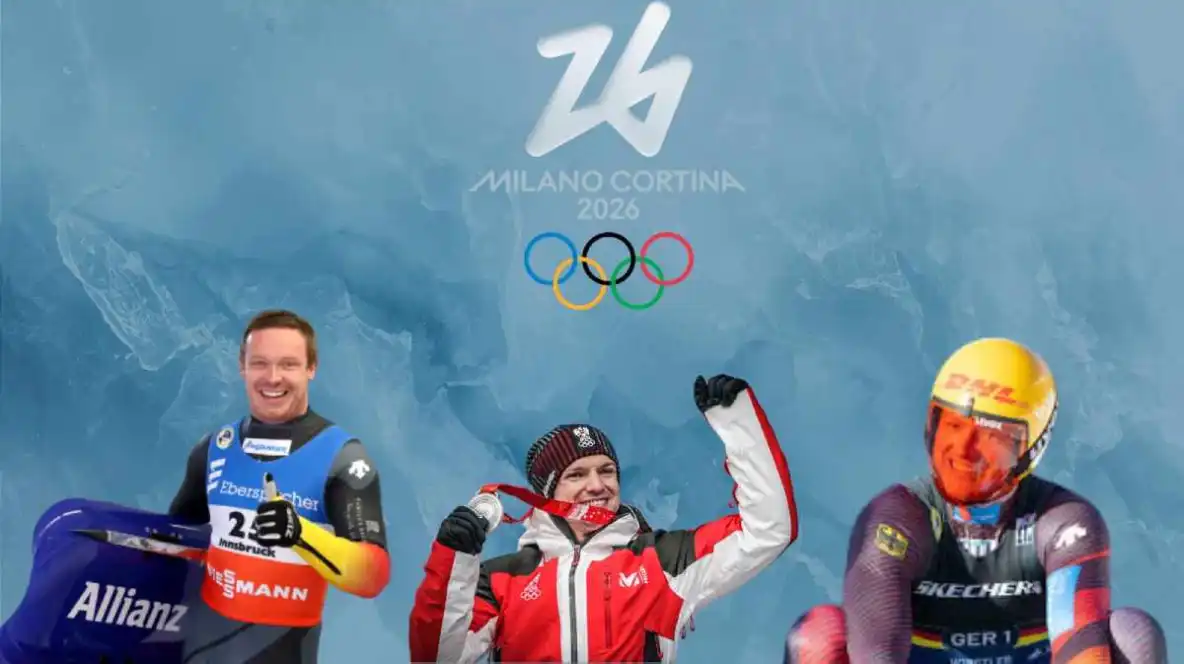
Imagine lying flat on your back on a tiny sled, feet pointed forward, racing down an icy track at 150 kilometers per hour with no brakes. That is luge, the fastest sport in the Winter Olympics, and the 2026 Milan Games will showcase this heart-pounding discipline on a brand new track built into the Italian mountains.
The Fastest Sport on Ice
Luge holds the title as the Winter Olympics’ most speed-obsessed event. Athletes rocket down frozen tracks reaching speeds that would earn you a speeding ticket on most highways. They experience forces of up to 6Gs on the curves, the same pressure fighter pilots feel during intense maneuvers. The crazy part? They have to stay relaxed while this happens because tension slows you down.
The sport traces its roots to 16th century Switzerland, where people used wooden sleds to travel through snowy mountain villages. The first international luge race happened in 1883 in Davos, Switzerland, when competitors raced down a 4-kilometer icy road. Luge became an Olympic sport at the 1964 Innsbruck Games, and it has delivered excitement ever since.
At Milan 2026, all the sliding action happens at the Cortina Sliding Centre in Cortina d’Ampezzo. This brand new track was built on the same mountain slope that hosted the 1956 Winter Olympics. The venue is named after Italian bobsled legend Eugenio Monti.
Germany: The Undisputed Kings
If there is one thing you need to know about Olympic luge, it is that Germany dominates like no other country dominates any Olympic sport. The Germans have won 38 of the 52 possible gold medals in luge history. They lead the all-time medal count with 87 total medals, followed by Italy with 18 and Austria with 25.
Why is Germany so good? The country has multiple Olympic-standard tracks where athletes train year-round. Their development system identifies talented young sliders early and provides world-class coaching. German engineering also produces some of the fastest sleds on the circuit.
The greatest names in luge history come from Germany. Georg Hackl won three consecutive gold medals from 1992 to 1998. Natalie Geisenberger retired after Beijing 2022 as the most decorated female luger ever, with six gold medals and one bronze. In doubles, Tobias Wendl and Tobias Arlt have won an incredible five gold medals together, making them the most successful partnership in the sport.
Italy’s Legendary “Cannibal”
Host nation Italy has its own luge legend: Armin Zoggeler, nicknamed “The Cannibal” for his ability to devour the competition. Zoggeler holds a record that may never be broken. He won medals at six consecutive Winter Olympics from 1994 to 2014, the only athlete in Olympic history (summer or winter) to achieve this feat in an individual event. His collection includes two gold medals, one silver, and three bronze.
Italian fans will be hoping their home track gives their athletes an advantage in 2026. The country’s doubles teams have improved significantly, with Andrea Votter and Marion Oberhofer leading a resurgence in that event.
Stars to Watch in Milan
The men’s singles competition features two German rivals battling for supremacy. Felix Loch, targeting his fifth Olympic Games, already owns gold medals from 2010 and 2014. But his teammate Max Langenhan has emerged as the new force in the sport since Beijing 2022. Austria’s Wolfgang Kindl, the silver medalist from Beijing, remains one of the most technically skilled sliders in the world.
Women’s singles looks like another German showcase. Anna Berreiter won silver in Beijing and has since captured both world and European titles, making her the favorite for gold. Julia Taubitz brings eight world championship titles and dozens of World Cup victories to Milan. Austria’s Madeleine Egle and Lisa Schulte will challenge for medals, with Schulte winning her first world title in 2024.
For Team USA, Emily Sweeney (now Emily Fischnaller) leads the charge. The 32-year-old four-time Olympian won bronze at the 2019 and 2025 World Championships, becoming only the second American singles slider to win multiple world championship medals. Ashley Farquharson and Summer Britcher add depth to the American women’s team.
New Event Debuts
Milan 2026 brings an exciting change to the luge program. For the first time, there will be separate men’s doubles and women’s doubles events, replacing the previous “open doubles” format that was technically mixed but always featured male teams.
In the debut women’s doubles competition, Austria’s Selina Egle and Lara Kipp enter as heavy favorites. The duo won back-to-back world titles in 2024 and 2025. Team USA’s Chevonne Forgan and Sophia Kirkby have medal potential after winning two world championship bronze medals and a World Cup race in 2024.
The men’s doubles should feature Wendl and Arlt chasing their fourth consecutive Olympic gold, a feat never accomplished in any doubles sliding sport. Latvia’s Martins Bots and Roberts Plume, along with Austria’s Thomas Steu and Wolfgang Kindl, will try to end German dominance.
Predictions for Milan 2026
Men’s Singles: Max Langenhan edges teammate Felix Loch for gold, with Austria’s Wolfgang Kindl taking bronze. The German internal competition produces an exciting battle.
Women’s Singles: Germany’s Anna Berreiter wins gold, with Julia Taubitz taking silver and Austria’s Madeleine Egle earning bronze. German dominance continues.
Men’s Doubles: Tobias Wendl and Tobias Arlt complete their historic four-peat for Germany. No team in any sliding sport has ever won four consecutive Olympic golds.
Women’s Doubles: Austria’s Selina Egle and Lara Kipp win the inaugural Olympic gold, with Team USA’s Forgan and Kirkby battling for bronze in an emotional race.
Team Relay: Germany extends their dominance with a fourth consecutive gold medal. Their depth across all events makes them nearly unbeatable.
Why Luge Captivates Us
Luge is pure speed and courage distilled into one event. There are no team dynamics to consider, no subjective judging scores. Just you, your sled, and the ice. The winner is determined by thousandths of a second over four runs, meaning one tiny mistake can cost you everything.
The athletes wear tight-fitting suits to reduce air resistance and specially designed shoes with tiny spikes to help push off at the start. They use their shoulders and legs to make tiny steering adjustments, shifting their weight to navigate the track’s curves. A perfect run looks effortless, but it requires years of training and nerves of steel.
At Milan 2026, watch for the start times. The luge start is critical because athletes generate their only propulsion in those first few seconds. They grip handles on the ice and rock back and forth before launching themselves down the track. A fast start can mean the difference between gold and no medal at all.
When the sleds start flying at the Cortina Sliding Centre in February 2026, you will witness athletes pushing human limits in one of the most thrilling events the Winter Olympics has to offer.