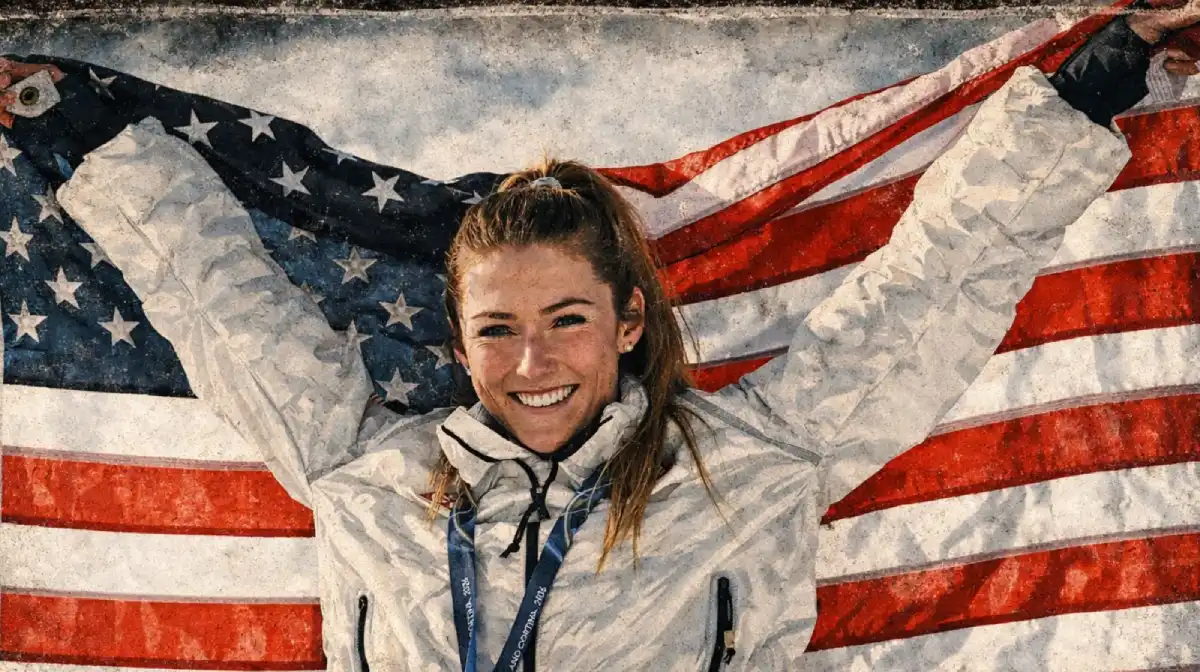

When Chloe Kim drops into the halfpipe at Livigno Snow Park this February, she won’t just be defending a title. She’ll be attempting something no snowboarder in Olympic history has ever done: win three consecutive halfpipe gold medals.
The 25-year-old American enters the Milano Cortina Games as the overwhelming favorite, armed with two Olympic golds, three consecutive World Championship titles, and a mental clarity she says she’s never had before. The question isn’t whether she belongs at the top of the sport. It’s whether anyone can stop her from making history on Italian snow.
The Path to Unprecedented Territory
Kim’s Olympic journey began with a coronation in PyeongChang 2018. At just 17 years old, she delivered a near-perfect final run of 98.25 points, becoming the youngest woman to win Olympic gold in snowboarding. She landed back-to-back 1080s that day, a trick combination no woman had ever executed at the Games. She finished nearly 10 points ahead of the silver medalist.
Four years later in Beijing, the pressure to repeat was immense. Kim admitted to mental breakdowns before competition and nerves that nearly paralyzed her. But when her boots locked into the bindings, the doubt evaporated. Her first-run score of 94.00 was untouchable. She became the first woman to win consecutive Olympic halfpipe gold medals, then used her remaining runs to attempt a 1260, three-and-a-half rotations in the air, a trick no woman had ever landed in competition.
She fell on both attempts. At the bottom of the pipe, she posted a photo of her face on Instagram with the caption: “Ow my butt.”
That audacity, that willingness to push even with gold secured, defines Kim’s approach to the sport.
A Champion Rediscovered
What happened after Beijing reveals why Kim arrives in Italy as more than just the reigning champion. She walked away.
Following her second Olympic gold, Kim announced she was stepping back from competition to prioritize her mental health. The endless cycle of training, media obligations, and sponsorship demands had drained her. She had achieved everything the sport could offer, yet felt empty.
“I just want to enjoy this moment, take it all in and then get back to it when I’m feeling ready,” Kim said at the time.
She sat out the entire 2022-23 season. She skipped the 2023 World Championships. For the first time since she was four years old, snowboarding wasn’t the center of her life.
The hiatus worked. Kim returned in the 2023-24 season with renewed purpose and, by her own admission, rediscovered why she fell in love with snowboarding in the first place.
“I think I’m back,” Kim declared after winning her third World Championship title in March 2025. “I really started to find the joy for the sport again, and I think that’s been a really big change for me, a positive change.”
The Numbers Behind the Dominance
Kim’s recent form suggests the break sharpened rather than dulled her abilities. In January 2025 at the Laax Open, she became the first woman to land a cab double cork 1080 in halfpipe competition, adding another historic trick to her arsenal. She won her eighth X Games gold medal that same month, tying Shaun White’s all-time record for superpipe victories.
At the 2025 World Championships in St. Moritz, she scored 93.50 on her opening run in challenging conditions, a two-hour weather delay and whiteout skies, then secured gold before her second attempt. Her winning margin over silver medalist Sara Shimizu of Japan was nearly three points.
The statistics across her career paint a picture of sustained excellence. Kim has competed in 19 World Cups, finishing on the podium 14 times with 12 victories, a 63 percent win rate. She holds every major title simultaneously: Olympic champion, World champion, X Games champion, and Youth Olympic champion. She is the only snowboarder to accomplish this feat.
What Makes Kim Unbeatable
Technical mastery alone doesn’t explain Kim’s dominance. Plenty of snowboarders possess elite skill. What separates her is amplitude, the height she achieves above the lip of the halfpipe, combined with the difficulty of her trick combinations.
Her signature runs typically include a switch double cork 1080, multiple 900s, and a massive closing trick that leaves judges reaching for high scores. In competition, she routinely scores above 90 when others struggle to break 85. Her worst days tend to be better than most athletes’ best.
There’s also her competitive mentality. Even after clinching gold in Beijing, she attempted tricks never before landed by a woman in competition. Her coach has indicated she’s already landed a 1440 in practice, four full rotations, though she has yet to debut it in competition.
The competition knows what’s coming. They train year-round hoping to close the gap. Yet when qualification begins at Livigno Snow Park on February 11, the conversation will still center on one question: by how much will Chloe Kim win?
The Road to Livigno
Kim clinched her spot on the U.S. Olympic team by winning the 2025 World Championships, automatically meeting selection criteria. She enters the Olympic season having already proven her form at the December 2025 World Cup in Copper Mountain, where she qualified first in her heat despite an uncharacteristic fall on her opening run.
The women’s halfpipe final is scheduled for February 13, 2026, at Livigno Snow Park in Italy’s Valtellina region. Kim will face a field that includes Japan’s rising stars Shimizu Sara and Mitsuki Ono, as well as South Korea’s Choi Gaon, who won the season-opening World Cup.
Recent developments have added a subplot to Kim’s quest. In January 2026, she dislocated her shoulder while training in Switzerland, sparking concerns about her Olympic participation. Kim quickly confirmed the injury wasn’t as severe as initially feared and declared herself ready to compete.
“I’m good to go,” she said, putting to rest speculation that the three-peat might slip away before it began.
More Than a Medal
For Kim, the three-peat represents something beyond personal achievement. It would cement her legacy as the greatest women’s halfpipe snowboarder in history, a distinction she arguably already holds but which a third consecutive gold would make undeniable.
Her journey also reflects broader themes that resonate beyond sport. Kim has spoken openly about mental health, normalizing conversations about the psychological toll of elite competition. She took a break when she needed one, returned stronger, and now stands on the verge of the most significant accomplishment of her career.
At 25, she remains in her physical prime with years of competition ahead. But there’s no guarantee of another Olympic cycle, no promise that her body will cooperate for Los Angeles 2030. This moment, this February in Italy, represents the culmination of everything she’s worked toward since her father first drove her 12 hours round-trip to Mammoth Mountain every weekend as a child.
No man or woman has ever won three consecutive Olympic snowboard halfpipe gold medals. On February 13, 2026, Chloe Kim will drop into the pipe with a chance to do what nobody has done before.
The snow in Livigno awaits. So does history.
Key Event Information
Event: Women’s Snowboard Halfpipe Final
Date: Friday, February 13, 2026
Venue: Livigno Snow Park, Valtellina, Italy
Qualifying: Wednesday, February 11, 2026