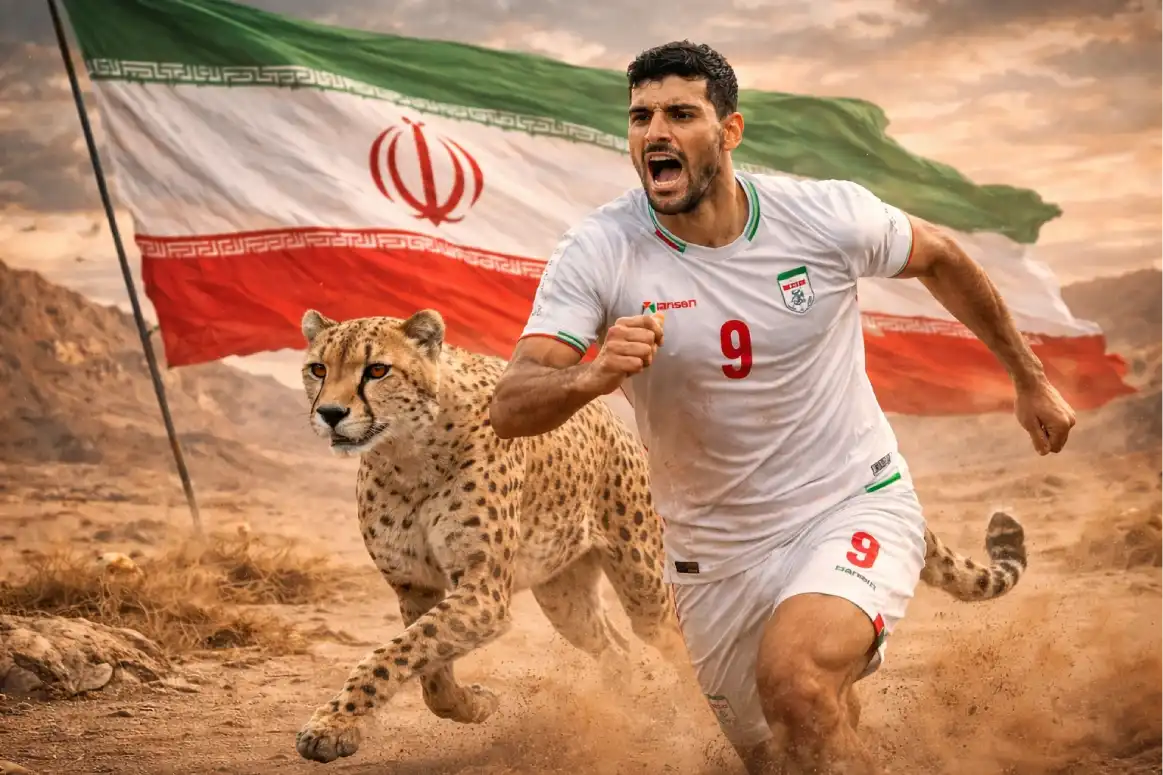
Six World Cups. Zero knockout round appearances. And now, a seventh tournament that might never happen for them at all.
Iran’s story heading into the 2026 World Cup is unlike anything football has ever seen. They earned their place on the pitch fair and square. They were the first non-host nation to qualify for this summer’s tournament, topping Asia’s toughest qualifying group with authority. Mehdi Taremi, Sardar Azmoun, a home crowd in Los Angeles that would have been wall-to-wall Iranian-Americans. Everything was set up perfectly for Team Melli’s greatest ever chance at finally breaking through the group stage.
Then the bombs started falling.
On February 28, 2026, the United States and Israel launched military strikes on Iran. Supreme Leader Ayatollah Ali Khamenei was killed in the first days of the campaign. Thousands of civilians have lost their lives. The country is at war with one of the three nations hosting the World Cup this summer.
On March 11, Iran’s sports minister Ahmad Donyamali went on state television and said what many had feared. “Considering that this corrupt regime has assassinated our leader, under no circumstances can we participate in the World Cup.” The players, he said, were not safe. The conditions for participation did not exist. It was the most dramatic statement in World Cup history.
Two days later, the Iranian national team fired back with a statement of their own, declaring that “no one can exclude” them from the tournament. The situation has been changing by the hour ever since. And as of today, nobody knows for certain whether Iran will be in North America this June.
This is the full story of Iran at the 2026 World Cup.
A History of Heartbreak on the Biggest Stage
Before the politics, before the war, before all of it, there is the football. And the football story of Iran at the World Cup is one of the most bittersweet in Asian football history.
This would have been Iran’s seventh World Cup overall and their fourth in a row. No Asian nation outside of a co-host has strung together four consecutive qualifications the way this generation has. That alone tells you how far Iranian football has come.
Their finest moments on the world stage are burned into the memories of anyone old enough to have watched them. At France 1998, they beat the United States 2-1 in one of the most politically charged matches in sporting history. The handshakes before kickoff, the flowers exchanged at the final whistle, the raw emotion of players who had grown up under sanctions and isolation. Football at its most powerful.
At Russia 2018, they stunned Morocco 1-0 and then delivered one of the matches of the tournament against Portugal. Ronaldo had a penalty saved by goalkeeper Alireza Beiranvand. Iran scored a dramatic late equalizer through Karim Ansarifard. Mehdi Taremi hit the side of the net in stoppage time with a winner right there for the taking. The final score was 1-1. Four points from the group, and they still went home. One point away from advancing. One late finish away from history.
At Qatar 2022, they beat Wales 2-0 and had a real chance of advancing. Then a 1-0 loss to the USA sent them home. Six tournaments. Zero knockout appearances. It is a record that haunts Iranian football.
That history is what made 2026 feel so different. The expanded 48-team format means more paths through the group stage. Group G pitted them against Belgium, Egypt, and New Zealand, a draw that felt genuinely winnable. Two games in Los Angeles, in front of one of the world’s largest Iranian diaspora communities. The stars were aligned.
Nobody could have predicted what happened next.
The Road to 2026: How They Got Here
Whatever happens in June, Iran earned their place at this tournament the hard way. They topped their AFC qualifying group with 23 points from 10 matches, scoring 19 goals and conceding just five. That is a dominant campaign by any measure.
The night that sealed it came on March 25, 2025 in Tehran. Iran trailed Uzbekistan 2-1 at home, the Azadi Stadium tense and restless. Enter Mehdi Taremi. The veteran striker leveled in the 52nd minute, then hit the winner in the 83rd to turn a potential disaster into a 2-2 draw that punched Iran’s ticket to North America. The crowd erupted. Players collapsed on the turf. After everything this generation had been through, they had done it again.
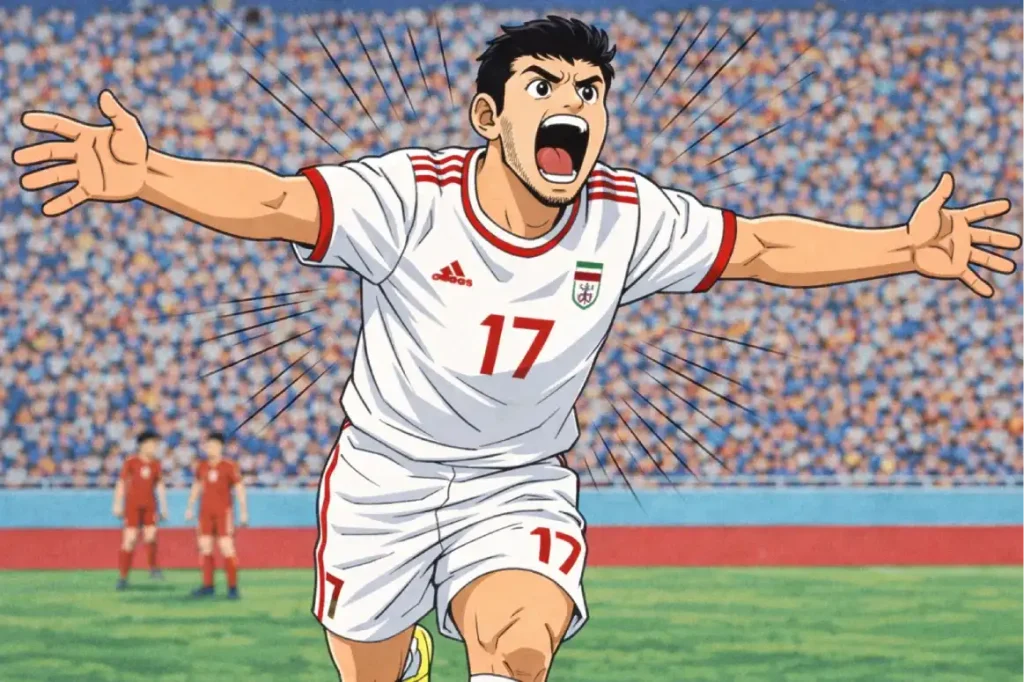
They were the first non-host nation to officially qualify for the 2026 World Cup. It felt like a statement.
The Players Who Were Ready to Make History
The squad Amir Ghalenoei built for this tournament is arguably the best Iran has ever assembled. Whether or not they get to show it on the biggest stage, the talent is undeniable.
Mehdi Taremi is the heartbeat of everything. The 33-year-old striker, who has played for Inter Milan and Olympiacos, is one of the most complete forwards Asia has ever produced. His movement is clever, his aerial ability is exceptional, and his big-game mentality is unquestioned. That qualifying header against Uzbekistan is just the latest chapter in a career built on pressure moments.
Sardar Azmoun, the striker nicknamed the “Iranian Messi” early in his career, gives Ghalenoei a completely different option up front. Quick, technically excellent, and capable of moments of individual brilliance. When both Taremi and Azmoun are on the same pitch, defenders have a serious problem.
Alireza Jahanbakhsh is the captain and the creative spark in midfield. The 32-year-old has spent years in European football and brings a level of tactical understanding that elevates the players around him. His reading of the game and his ability to connect defence and attack are central to how Iran function.
In goal, Alireza Beiranvand has been one of the most consistent keepers in Asian football for a decade. His shot-stopping is elite and his distribution allows Iran to build quickly out from the back.
The Manager Who Built Something Special
Amir Ghalenoei is the most decorated coach in Iranian club history and a man who understands exactly what this generation of players is capable of. In his second stint with the national team, he built a system around defensive structure and devastating counter-attacks. He never tried to out-possess world-class opponents. He was content to sit deep, stay compact, and hurt teams on the break through Taremi’s movement and Azmoun’s pace.
It is a pragmatic approach that very nearly worked multiple times. Ghalenoei knows how to prepare a team for a tournament. The tragedy is that circumstances beyond his control may mean his best-ever squad never gets to prove it on the biggest stage.
Group G and the “Home” Advantage That Almost Was
When the World Cup draw placed Iran in Group G with games in Los Angeles and Seattle, the football world noticed something extraordinary. Two of their three matches would be played in a city home to hundreds of thousands of Iranian-Americans, one of the largest Iranian diaspora communities on the planet. SoFi Stadium in Los Angeles, packed with Iranian fans cheering on Team Melli against Belgium and New Zealand. It would have been electric.
| Match | Date | Opponent | Venue | Time (ET) |
|---|---|---|---|---|
| 1 | June 15, 2026 | New Zealand | SoFi Stadium, Los Angeles | 9:00 PM |
| 2 | June 21, 2026 | Belgium | SoFi Stadium, Los Angeles | 3:00 PM |
| 3 | June 26, 2026 | Egypt | Lumen Field, Seattle | 11:00 PM |
The schedule still exists. The dates are still printed. Whether Iran will be there to honour them is the question nobody can answer right now.
What Happens Next: FIFA’s Impossible Decision
FIFA finds itself in completely uncharted territory. No team has withdrawn from a World Cup after qualifying in the modern era. The last time it happened was 1950, when India and France pulled out before travelling to Brazil. The governing body has stated it is “monitoring the situation” and pointed to Article 6.7 of its regulations, which gives FIFA sole discretion to decide what happens if a member association withdraws.
There are two main options on the table. FIFA could reduce Group G to three teams and adjust the bracket accordingly, which creates complications for the knockout phase mathematics. Or they could replace Iran with another nation, almost certainly from Asia. The leading candidate right now is Iraq, who are already in the intercontinental playoff on March 31 to potentially qualify for the tournament anyway. Iraq coach Graham Arnold has publicly asked FIFA to delay that playoff until closer to the tournament, partly to give the Iran situation time to resolve.
A key date on the calendar is April 30, when the FIFA Congress meets. Sources have told ESPN that no firm decision is likely before then. FIFA is believed to be hoping the situation resolves itself, or at minimum becomes clearer, before they are forced to act.
There is also the question of punishment. If Iran’s withdrawal is confirmed and FIFA does not classify it as force majeure, the federation faces fines of at least $316,000 and could be required to return the $1.5 million in tournament preparation money already received. Given the extraordinary circumstances, most legal experts believe a force majeure classification is likely.
On the other side of the argument, the Iranian national team themselves have not gone quietly. Their response statement, declaring that “no one can exclude” them from the tournament, suggests the players may not be aligned with their government’s position. The human stories inside that squad, players who have dedicated their careers to reaching this moment, are heartbreaking to consider.
A Nation Watching and Waiting
The Iranian-American community in Los Angeles, the one that was supposed to pack SoFi Stadium in their thousands, is living through something impossibly complicated. Many fled the Iranian government. Many oppose the regime that their sports minister speaks for. Many still love their football team with everything they have. The idea that their team might not come to play in their city, in their neighbourhood, is a wound that goes far beyond sport.
Iranian-Americans interviewed in Westwood, the heart of the community in Los Angeles, have offered nuanced and sometimes contradictory views. Some say they cannot support a team linked to a government they oppose. Others say the players are separate from the politics and deserve to play. Nearly all of them are grieving something, even if they cannot quite name what it is.
This was supposed to be football’s great homecoming story for a diaspora. It has become something far more complicated.
The Verdict: A Story Still Being Written
There is no clean prediction to offer here. There is no “they will reach the Round of 32” or “watch out for Taremi” to wrap this article up with a bow. The situation is too raw, too fluid, and too serious for comfortable football analysis.
What we can say is this: the Iranian football team that qualified for this World Cup was the best generation of players their country has ever produced. They deserved their place in North America. They earned it on the pitch with one of Asia’s most dominant qualifying campaigns in recent memory. Whatever decision FIFA ultimately makes, whatever political forces shape what happens next, none of that takes away from what Taremi, Azmoun, Jahanbakhsh and their teammates achieved.
The 2026 World Cup begins on June 11. By then, we will know whether Iran’s incredible football story continues or whether it gets swallowed by events that no sport, however powerful, can fully contain.
Either way, nobody will forget this.