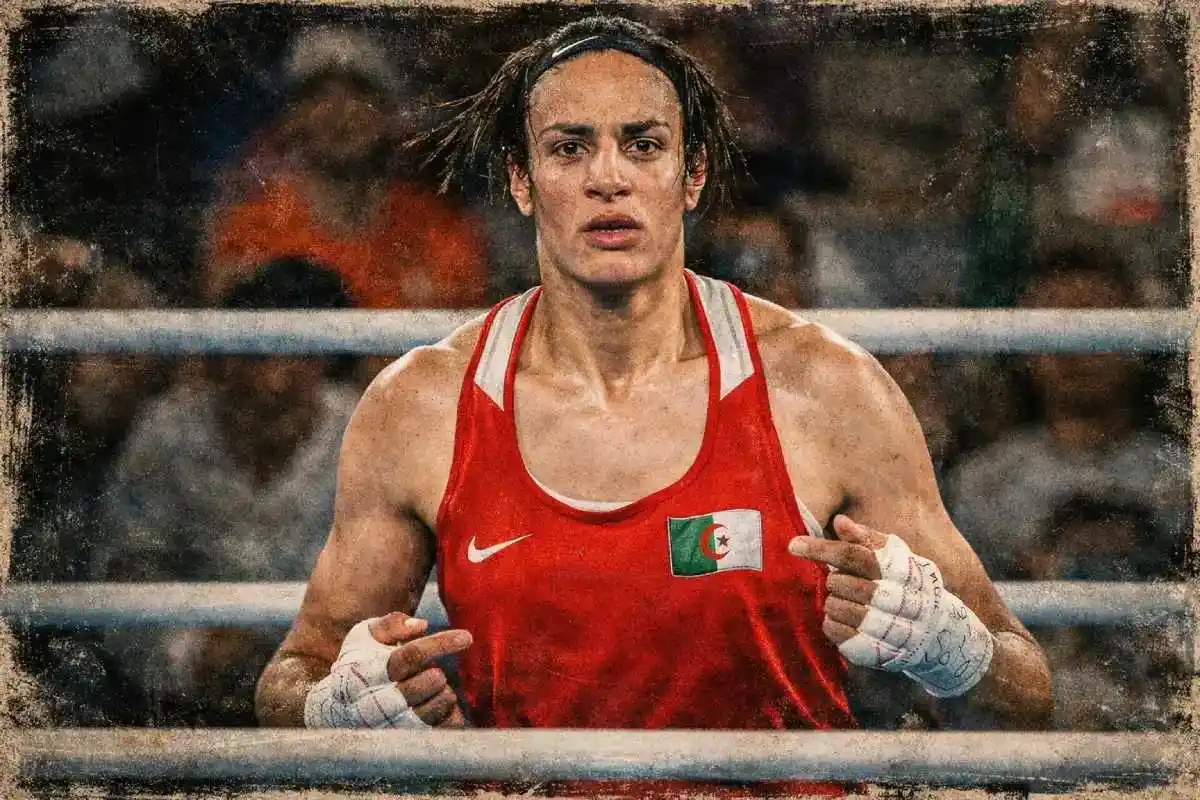
Imane Khelif won Olympic gold in Paris. She defended her right to compete against scrutiny that followed her throughout the tournament. Now, she’s willing to submit to testing requirements if it means she can fight again in Los Angeles.
The Algerian boxer told CNN on Wednesday that she would accept sex testing conducted by the International Olympic Committee for the 2028 Games. “Of course, I would accept doing anything I’m required to do to participate in competitions,” Khelif said. “I have nothing to hide.”
The statement comes as Khelif, 26, continues navigating controversy that has followed her since the 2023 World Championships. That year, the International Boxing Association disqualified both Khelif and Taiwanese fighter Lin Yu-ting for allegedly failing gender eligibility tests.
The IOC cleared Khelif to compete at the 2024 Paris Olympics, where she won women’s welterweight gold. The decision highlighted the growing divide between the IBA and the Olympic body, which had stripped the IBA of its recognition in June 2023.
The Context That Matters
Khelif has always competed in women’s categories throughout her career. She is not transgender. She was assigned female at birth and identifies as a woman.
“I’m not transgender. I’m a woman,” Khelif told CNN. “I want to live my life. Please do not exploit me in your political agendas.”
That statement addresses the misinformation that spread during and after the Paris Olympics. Some commentators, including US President Donald Trump, incorrectly referred to Khelif as a “male boxer.” Trump made those comments after signing an executive order preventing transgender women from competing in female sports categories.
The confusion stems from the IBA’s 2023 disqualification. The organization claimed Khelif and Lin failed gender eligibility tests but never publicly released the specific test results or methodology. The IOC disputed the IBA’s findings and allowed both fighters to compete in Paris.
Understanding the timeline and the institutional conflict is essential to understanding Khelif’s situation. This isn’t a simple story about testing. It’s about competing governing bodies, disputed test results, and an athlete caught in the middle.
The New Testing Landscape
World Boxing, a new organization granted provisional recognition by the IOC in February 2025, has introduced mandatory genetic tests to “determine sex at birth and eligibility to compete.”
When announcing the policy change, World Boxing cited Khelif’s case. The organization later apologized for that reference.
Khelif lodged an appeal with the Court of Arbitration for Sport in August over World Boxing’s mandatory testing requirements. That hearing remains pending.
Her willingness to undergo testing conducted by the IOC represents a nuanced position. She’s not objecting to testing itself. She’s objecting to testing conducted by organizations whose credibility or methodology she questions.
“They should protect women, but they need to pay attention that while protecting women, they shouldn’t hurt other women,” Khelif told CNN.
That statement captures the complexity. Eligibility standards exist for legitimate reasons. But the implementation of those standards, and who controls that implementation, creates genuine questions about fairness and process.
The Human Cost
Khelif won Olympic gold in Paris, the pinnacle achievement for any boxer. But the scrutiny overshadowed her victory.
She faced questions about her gender throughout the tournament. Social media amplified misinformation. Political figures used her case to advance policy agendas she didn’t endorse. The victory came with a cost that had nothing to do with boxing.
Athletes shouldn’t have to defend their right to exist while competing at the highest level. That Khelif must do so, even after winning gold and being cleared by the IOC, points to larger issues within sports governance and public discourse.
Her statement about political exploitation isn’t hyperbolic. Her case has been cited in debates about transgender athletes in sports despite the fact that she is not transgender. The distinction matters, but gets lost in broader cultural arguments.
What Testing Actually Means
Sex testing in sports has a complicated history. Early methods were invasive, degrading, and often inaccurate. Modern approaches attempt to balance fairness with dignity, but consensus on methodology remains elusive.
Genetic testing can identify chromosomal patterns. Hormone testing measures testosterone levels. Both approaches have limitations and edge cases that defy simple categorization.
Some athletes have differences in sex development that don’t fit typical male or female biological patterns. These conditions are naturally occurring and don’t constitute intentional deception or rule-breaking.
The question sports organizations face isn’t whether to have eligibility standards. It’s how to implement those standards in ways that protect competitive fairness without excluding athletes for conditions beyond their control.
Khelif’s willingness to undergo IOC-conducted testing suggests she believes she would pass whatever protocols the Olympic body implements. Her objection seems focused on the IBA’s process and conclusions, not testing itself.
The Path to Los Angeles
The 2028 Los Angeles Olympics are more than three years away. Boxing’s place in those Games isn’t guaranteed, given the sport’s ongoing governance issues.
The IOC’s recognition of World Boxing as a provisional governing body represents progress toward stability. But the relationship remains conditional, and the sport must demonstrate improved governance to secure its Olympic future.
Khelif’s participation in 2028 depends on multiple factors. She must maintain competitive form through age 30. She must navigate whatever eligibility requirements World Boxing and the IOC implement. She must continue competing despite the scrutiny that has defined her recent career.
Her statement to CNN indicates she intends to pursue that path. “Of course, I would accept doing anything I’m required to do to participate in competitions,” she said.
That willingness reflects both her commitment to the sport and her confidence in her eligibility.
The Broader Implications
Khelif’s case highlights tensions that extend beyond one athlete. Sports organizations worldwide are grappling with how to implement eligibility standards that balance fairness, inclusion, and scientific understanding of biological diversity.
The IBA’s handling of Khelif’s case demonstrated what not to do. Disqualifying athletes based on undisclosed tests using unclear methodology creates justified skepticism about motives and accuracy.
The IOC’s decision to clear Khelif for Paris demonstrated institutional disagreement about both process and conclusions. But it also created a situation where an athlete competed under a cloud of controversy she didn’t create and couldn’t fully dispel.
World Boxing’s approach, introducing mandatory testing while apologizing for citing Khelif’s case, suggests the organization recognizes the sensitivity required. Whether the new protocols prove more credible than the IBA’s remains to be seen.
What Happens Next
Khelif continues training and competing while her appeal to CAS remains pending. The court will eventually rule on World Boxing’s mandatory testing requirements and whether they comply with established legal and ethical standards.
The IOC will develop its own eligibility protocols for the 2028 Games. Those protocols will apply to all athletes, not just Khelif, and will shape how boxing addresses these questions going forward.
Khelif’s public statements suggest she’s prepared to comply with reasonable requirements. Her objections center on process and institutional credibility, not the concept of eligibility standards.
She won Olympic gold. She defended her right to compete. She’s willing to submit to testing conducted by an organization she trusts.
The rest is up to the institutions that govern the sport and whether they can implement policies that protect competitive fairness without causing unnecessary harm to athletes caught in bureaucratic and political crossfire.
Khelif’s closing statement to CNN framed the issue clearly: “I want to live my life. Please do not exploit me in your political agendas.”
She’s a boxer who wants to compete. Everything else is noise she didn’t create but has been forced to manage.
The 2028 Olympics will provide an answer about whether the sport can move forward with clarity and fairness. Until then, Khelif waits, trains, and prepares to defend whatever testing requirements legitimate governing bodies implement.
She has nothing to hide. She just wants to fight.