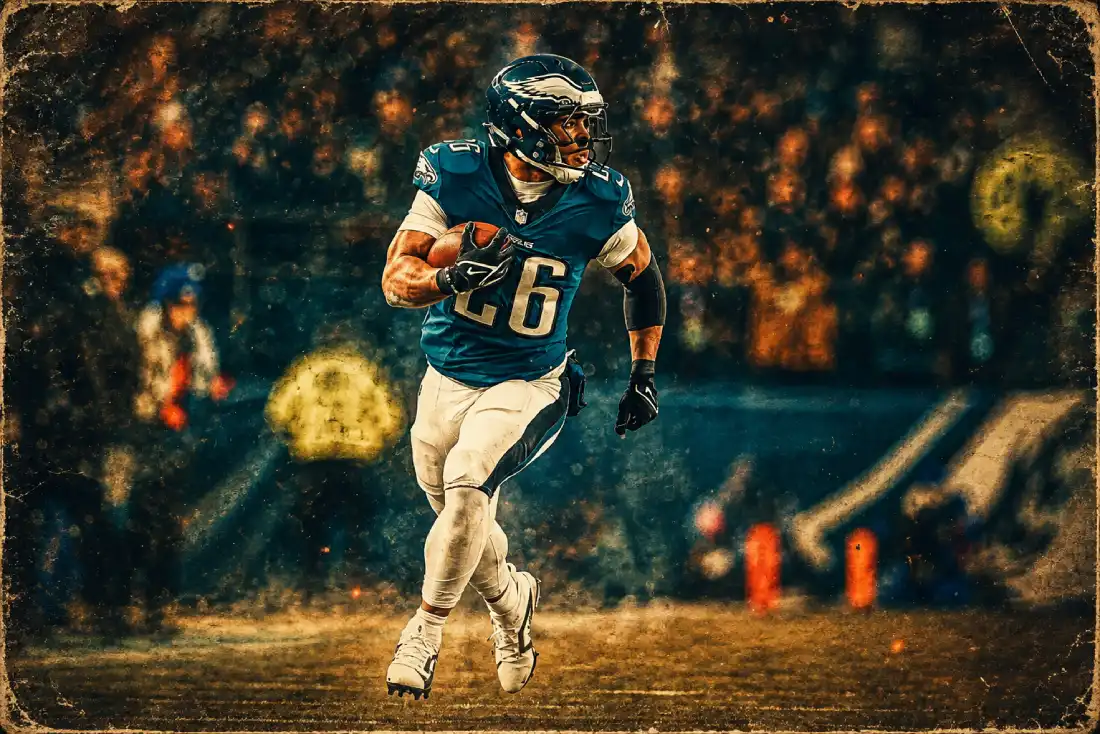
Saquon Barkley does not hide how he feels about joint practices. After two days sharing a field with the New England Patriots, he made that clear again. The Eagles running back called the format mostly unnecessary on Thursday, even as he admitted his own role in the tension that surrounded it.
“I’m the wrong guy to ask because I hate joint practices, to be honest. I think one day is good,” Barkley said when asked about the benefits of the two-day session in Foxborough. He did not soften the point. “More times than not nothing good comes out of it,” he said. Good days bring real work, Barkley explained, but they often spiral into shoving matches and players trading jabs. One example he gave: “I don’t know about that but you’re this.” “It’s immature when you get to that level,” he said.
Then Barkley turned the lens on himself. “I have to do a better job, too, because I’m a little troublemaker sometimes, but I was good this week,” he said. That kind of self-accounting, offered without prompting, says something about where Barkley is right now. He is not asking anyone to excuse the chaos. He is naming his part in it.
What actually happened on the field
The chaos was real. Barkley, long known for mixing it up with defenders in practice, appeared to be at the center of at least one scrum Thursday. In a separate sequence, Eagles tackle Lane Johnson and Patriots linebacker K.J. Britt grabbed each other by the face mask. Several other skirmishes broke out through the day, most of them between Philadelphia’s offense and New England’s defense.
Barkley framed it as a predictable byproduct of physical football rather than a real problem. “That’s bound to happen after Day 2,” he said. “Obviously football is a physical game within itself and it’s just a little extra pushing and shoving. We’ve also got to do a better job of not allowing that to have a factor in our practice.”
That last line matters. Barkley is not dismissing the fighting. He is separating it from the actual work the Eagles came to Foxborough to do. That work meant testing a new offense against unfamiliar opponents before the games start to count.
A new offense finding its footing
Philadelphia is installing a new scheme under first-year offensive coordinator Sean Mannion, and the joint practices offered an early, honest look at where it stands. The new wide zone running scheme looked effective. Barkley and the Eagles backfield broke off several long runs against Patriots defenders seeing it for the first time. The passing game told a rougher story. Jalen Hurts threw five interceptions across the two days, a sign the offense is still working through its early growing pains.
Defensive coordinator Vic Fangio saw real value in the exercise, and he said so without reservation. “I love doing these things. I think these things are great,” Fangio said. “I wish we would do another one. It’s great to go against a new team, new schemes, new players. You learn things. You’re going to get unscouted looks and plays and see how people react. These things are tremendous and can’t get enough of it.”
The contrast between Fangio’s enthusiasm and Barkley’s fatigue is not really a contradiction. A defensive coordinator building a new unit wants every rep against a scheme he has not already memorized. A veteran running back who has spent his career absorbing hits wants fewer chances for practice to turn physical for no real reason. Both men are describing the same two days. They are just weighing the cost differently.
| Storyline | Where it stands |
|---|---|
| Barkley on joint practices | Prefers one day, calls extra physicality “immature” |
| Run game | New wide zone scheme producing long gains early |
| Pass game | Jalen Hurts threw five interceptions over two days |
| Sideline incident | Lane Johnson and K.J. Britt grabbed face masks |
| Fangio’s view | Called the sessions “tremendous,” wants more |
What comes through in Barkley’s comments is not resentment toward the Patriots or toward joint practices as a concept. It is a running back’s honest accounting of a format that asks players to compete hard against strangers without the structure of an actual game. He wants the work. He does not want what tends to come with it.
The Eagles are still teaching themselves a new offense with the regular season approaching. That tension between value and cost is exactly what these two days were supposed to surface. Barkley, by his own admission, brought both the good and the trouble.