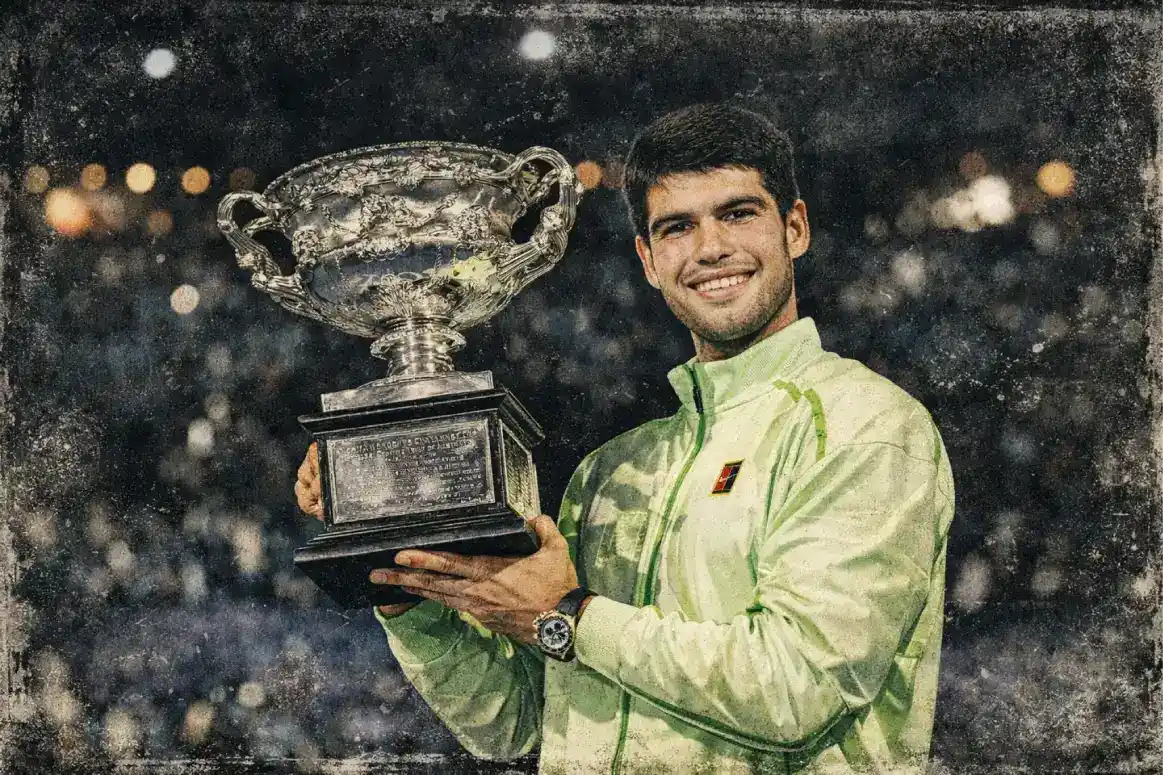
Carlos Alcaraz walked off Rod Laver Arena on Sunday night having achieved what only nine men in tennis history have accomplished. He did it faster than any of them.
The 22-year-old Spaniard defeated Novak Djokovic 2-6 6-2 6-3 7-5 to claim his first Australian Open title and complete the career grand slam. The victory makes Alcaraz the youngest man ever to win all four major championships, eclipsing Don Budge’s record that stood since 1938.
“It is a dream come true for me,” Alcaraz said after the match. His seven career grand slam titles now include doubles at Roland Garros, Wimbledon and the US Open, with the Australian Open completing the set.
Djokovic, bidding to become the oldest grand slam champion at 38 and claim a standalone 25th major title, understood the significance immediately. “I think the best word to describe it is historic, legendary,” the Serbian said of Alcaraz’s achievement.
The Shift That Changed Everything
The opening set belonged entirely to Djokovic. His court positioning was textbook, his returns sharp, his movement economical. He took it 6-2, and the Rod Laver Arena crowd sensed they might witness the oldest major champion in history.
Then Alcaraz adjusted. The second set showed why he’s ranked No. 1 in the world. He began attacking Djokovic’s second serve with more aggression, moving forward to cut off angles. His forehand, which had misfired in the first set, found its range. He took the second set 6-2, a mirror image of the opener.
The third set was tactical chess. Alcaraz varied his serve placement, keeping Djokovic guessing. When the Spaniard broke serve to go up 4-2, the momentum shift was complete. He closed out the set 6-3.
The fourth set tested both men. Djokovic, drawing on decades of experience, refused to fold. He saved break points, extended rallies, and made Alcaraz earn every point. But at 5-5, Alcaraz broke through. Two games later, he served out the championship.
Two Paths Crossing at History’s Intersection
For Djokovic, the loss stings in ways that go beyond the scoreboard. He came into this tournament having beaten defending champion Jannik Sinner in a five-set semifinal epic. That match alone cemented his status as tennis’s great survivor, still competing for majors at an age when most champions have long retired.
“It’s an incredible achievement for me to be able to play finals, be couple of sets away maybe to win a championship,” Djokovic said. “Of course, after a loss, it’s a bitter feeling. But nevertheless I have to be content with this result.”
The disappointment is understandable. Djokovic remains tied with Margaret Court at 24 major singles titles. The standalone record, which seemed inevitable just a few years ago, now feels less certain. Time doesn’t stop, even for the greatest.
For Alcaraz, this was about completing something that seemed almost preordained. Before this year, he’d never advanced past the Australian Open quarterfinals. The hard courts in Melbourne hadn’t clicked for him the way clay at Roland Garros or grass at Wimbledon had.
But champions find a way. After the final point, Alcaraz walked to the courtside camera and wrote: “Job finished. 4/4 complete.”
Four words that sum up a career-defining moment.
The Youngest Ever to Do It
Alcaraz’s path to the career grand slam is remarkable not just for its speed but its dominance. He won his first major at the 2022 US Open at age 19. Four years later, he has seven majors and sits atop the tennis world.
The record books tell the story. Rod Laver completed the career slam at 24. Rafael Nadal did it at 24. Roger Federer at 27. Djokovic himself was 29 when he finally won the French Open to complete his set.
Alcaraz did it at 22 years, 4 months. No one in the Open Era has done it faster. No one in tennis history, dating back to Budge in 1938, has achieved it younger.
The numbers also reveal something extraordinary. Alcaraz now has two titles each at the French Open, Wimbledon and US Open. With one Australian Open, he’s just a repeat Melbourne championship away from joining the double career grand slam club.
Only four men have achieved that: Rod Laver, Roy Emerson, Rafael Nadal and Djokovic. Nadal was 35 when he completed it with a second Australian Open. Djokovic was 34 when a second French Open gave him the double slam.
Alcaraz could do it at 23 if he defends next year.
What Drives Alcaraz Now
After accomplishing what most players never achieve, the question becomes: what’s next?
“I hate losing, so that’s my motivation,” Alcaraz said. “Trying to lose as less as I can.”
His goals remain ambitious. He wants to win at least one of every Masters 1000 tournament. He’s never won the ATP Finals, and that remains a target. The Davis Cup, representing Spain, sits high on his list.
“I set up some other goals for the season, and I will try to be ready to get those goals,” he said.
It’s the mentality of a champion who understands that records are made to be broken. That history is written by those who refuse to be satisfied.
Djokovic knows this better than anyone. His career has been defined by chasing records that seemed untouchable. Now, at 38, he watches a 22-year-old complete one of tennis’s rarest feats while denying him his own piece of history.
“After a loss, it’s a bitter feeling,” Djokovic said. But he also recognized the moment for what it was. Legendary.
The torch doesn’t get passed in tennis. It gets taken. On Sunday night in Melbourne, Carlos Alcaraz took it with both hands and wrote his name in the record books faster than anyone before him.
The career grand slam is complete. The question now is how much more he can achieve.