Twenty-four years. That is how long Turkish football fans have been waiting for this moment.
Since Hakan Sukur scored the fastest goal in World Cup history in 2002 and Turkey walked off the pitch with bronze medals around their necks, the Crescent-Stars have watched five World Cups from their sofas. They missed 2006, 2010, 2014, 2018, and 2022 by varying degrees of heartbreak. Playoffs lost, qualification games botched, dreams put on hold again and again. A nation of 85 million people, passionate about football to its core, stuck on the outside looking in.
Not this time.
Kerem Akturkoglu’s 53rd-minute goal in Pristina on March 31, 2026 sent thousands of Turkish fans streaming into the streets of Istanbul, Ankara, and cities across the country. Türkiye are going to North America. After all the near misses and the painful nights, they are finally heading back to the biggest stage in football.
Here is everything you need to know about Türkiye heading into the 2026 FIFA World Cup.
Bronze Medals and Record Books: Turkey’s World Cup Story So Far
Turkey’s World Cup history is short but impossible to forget. This will be only their third appearance at the tournament, and the first two could not have been more different from each other.
The debut came at the 1954 World Cup in Switzerland. Turkey qualified in remarkable fashion, advancing after a play-off against Spain that ended with a literal coin toss. In the tournament itself, they hammered South Korea 7-0 in one of the most lopsided results of the era. But defeats to West Germany and a subsequent playoff loss meant they went home early. The foundations had been laid, though. Turkish football had arrived.
Then came the great silence. For almost half a century, Turkey failed to qualify for another World Cup. There were near misses along the way, but nothing got them over the line.
That all changed at the 2002 World Cup in South Korea and Japan.
What Turkey did at that tournament still takes your breath away when you think about it. They went there with genuine quality but modest expectations, and they just kept winning. They beat Japan in the round of 16. They beat Senegal in the quarterfinals on a golden goal. They were knocking on the door of the final itself before Brazil stopped them 1-0 in the last four. That Brazil team went on to win the whole thing.
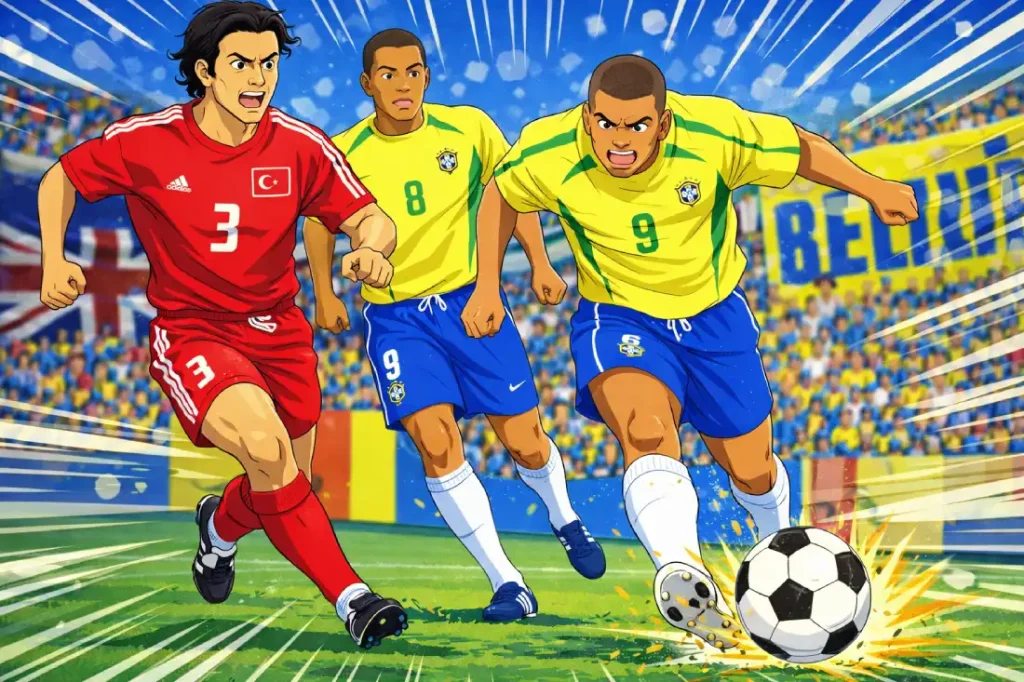
Then came the bronze medal match against co-hosts South Korea. Just 10.8 seconds after kick-off, Hakan Sukur had the ball in the net. It remains the fastest goal in World Cup history to this day. Turkey won 3-2 and came home as bronze medalists. Sukur, who had gone the entire tournament without scoring before that match, had written himself into the record books at the very last opportunity.
After 2002, Turkey returned to the wilderness. No more World Cups. No bronze medals. Just a national team that kept promising and kept falling short. Now, 24 years later, they get to write a new chapter.
Road to 2026: Grit, Goals, and a 6-0 Humbling to Recover From
Turkey’s journey to this World Cup was not smooth. It had moments of real quality and moments of genuine embarrassment, and it needed two hard-fought playoff wins to finally get over the finish line.
In UEFA qualifying Group E, Turkey were drawn alongside defending European champions Spain, plus Georgia and Bulgaria. Finishing second and reaching the playoffs was the realistic goal from the start. Getting there, though, tested this squad’s character to its absolute limits.
The opening group encounters were straightforward enough. Turkey beat Georgia twice, 3-2 away and 4-1 at home, and crushed Bulgaria 6-1 in Sofia. Those were the games they were supposed to win, and they delivered. But the meetings with Spain told a very different story.
At home in Konya in September 2025, Spain were merciless. Mikel Merino scored a hat trick. Pedri got two. Ferran Torres added another. Final score: Turkey 0-6 Spain. It was a sobering afternoon that exposed exactly how big the gap can be against the very best teams in Europe. Some Turkey fans were asking serious questions about whether this squad was really good enough.
Those Turkey players remembered that afternoon when they traveled to Seville for the final group match in November. They walked into the La Cartuja Stadium knowing Spain were still unbeaten, still unscored on in qualifying, still perfect. What happened next became one of the most memorable Turkey performances in years.


Dani Olmo put Spain ahead in the fourth minute. Turkey refused to fold. Deniz Gul pulled them level just before half-time. Then, nine minutes into the second half, Salih Ozcan stepped back and curled a long-range finish into the net to put Turkey 2-1 ahead in Spain. The Turkey fans watching at home could barely believe what they were seeing. Those were the first two goals Spain had conceded in the entire qualifying campaign, and it was their first draw too.
Spain equalized through Mikel Oyarzabal in the 62nd minute, and the match ended 2-2. Turkey had shown they could fight back. They finished second in Group E and advanced to the playoffs.
First up was Romania, at the Besiktas Stadium in Istanbul on March 26. Another tight game. Ferdi Kadioglu scored the only goal of the match to send Turkey into the playoff final with a 1-0 win. Then came Kosovo in Pristina, and the night that changed everything.
The Night That Ended 24 Years of Waiting
March 31, 2026. Fadil Vokrri Stadium, Pristina, Kosovo.
This was the moment everything had been building toward. Kosovo, ranked 77th in the world and chasing a first-ever World Cup appearance, against Turkey, a nation desperate to end two and a half decades of pain. Around 700 Turkish fans made the journey to Kosovo. Back home, millions gathered around screens in living rooms, cafes, and public squares. Cities set up giant outdoor screens so fans could watch together. The stakes could not have been higher.
The first half was tense and incredibly tight. Kosovo made life hard, pressing relentlessly and refusing to give Turkey space to play. Neither side could find a breakthrough. At half-time, it was still 0-0, and the anxiety was unbearable for everyone watching.
Then, eight minutes into the second half, Türkiye broke the deadlock.
Kenan Yildiz burst forward on the left and played a cutback into the box. The ball found its way to Orkun Kokcu, whose effort was diverted directly into Akturkoglu's path. He did not think twice. Low, powerful, right to the base of the post. The goalkeeper had no chance. Kosovo 0-1 Türkiye.
The 700 Turkish fans in the away end went absolutely wild. Akturkoglu ran off screaming. On the touchline, coach Vincenzo Montella leaped to his feet. Kosovo pushed desperately for an equalizer in the final 37 minutes. Turkey dug in. They defended set pieces, broke up attack after attack, managed the clock with intelligence. When the final whistle came, the Turkish players collapsed to the turf in a mixture of relief and pure joy.
Hakan Calhanoglu, Arda Guler, and Kenan Yildiz waved giant Turkish flags in front of the travelling support. Players were in tears. Back home, people drove through the streets honking their horns and hanging out of car windows with flags flying. The 24-year wait was finally, officially over.
At his post-match press conference, Montella was drenched in water by his players. He told the gathered journalists he felt like a Turk in everything he does. The Turkish Football Federation president had previously promised Montella Turkish citizenship if Turkey qualified for the World Cup. "The passport is just a formality for me," Montella said. "I am always like a Turk."
The Stars Who Could Light Up North America
Türkiye have one of the most exciting young squads at this World Cup. The combination of elite European experience and raw teenage brilliance makes them a genuinely compelling team to follow.
Arda Guler is the name every football fan needs to know. The Real Madrid attacking midfielder was born in February 2005 and will be 21 when the tournament begins. At Euro 2024, he scored against Georgia in Turkey's opening match and became the youngest player ever to score on their European Championship debut, breaking a record that had belonged to Cristiano Ronaldo since 2004. He plays with a freedom and instinct that belongs to a different era. His ability to drift into space, see passes others cannot imagine, and deliver under pressure makes him Türkiye's single most dangerous weapon. On March 14, 2026, less than three weeks before the Kosovo playoff, he scored a goal from his own half during a match for Real Madrid that set a new record for the longest goal ever scored in La Liga. That is the kind of player you are talking about.
Hakan Calhanoglu is the captain and the heartbeat of this team. The Inter Milan midfielder will turn 32 during the tournament and brings something Guler cannot yet offer: experience at the very highest level of club football, the ability to control tempo, and the composure to make the right decision when games are on the line. In Turkey's playoff matches, his side averaged 68 percent possession and 87 percent passing accuracy. He has been to Euros, won trophies in Serie A, and knows exactly how to handle the intensity of a knockout atmosphere. Turkey need him at his best every single game.
Kenan Yildiz is the other young star competing for your attention. The Juventus forward, born May 4, 2005, is 21 at tournament time and has already shown the world what he can do. He scored four goals in Turkey's qualifying run and provided the cutback that created Akturkoglu's World Cup-winning strike. He has physicality and directness that complement Guler's technical brilliance perfectly. Give those two freedom in the same team and opposing defences face a serious problem.
Kerem Akturkoglu, the man who scored the goal that sent Turkey to the World Cup, has made himself a national hero. The Fenerbahce forward's finish against Kosovo was worth every bit of the celebrations that followed. He is mobile, relentless in his movement, and has a gift for appearing in exactly the right place at exactly the right moment.
Ferdi Kadioglu at left back has become one of Turkey's most consistent performers. The Brighton defender scored the crucial goal against Romania in the playoff semi-final and contributes genuine attacking quality from deep. His combination with the players ahead of him on the left side of the pitch is one of Turkey's most productive relationships.
Merih Demiral leads the defensive unit and brings physical presence, aerial dominance, and the authority the backline needs. He communicates constantly and makes himself an organizational presence the rest of the defence can rely on.
The Italian Who Made Himself a Turk
Vincenzo Montella was appointed Turkey's head coach in September 2023, and from the very beginning he described this group of players as a special generation with genuine potential. Nearly three years later, he has been proven right.
Montella is 51 years old and had a celebrated playing career in Italian football, most famously with Roma where he won the Serie A title in 2001. His nickname as a player was "Aeroplanino," which translates loosely as "little airplane," because of his trademark goal celebration where he spread his arms wide like wings. He was good enough to earn 20 caps for Italy, including appearances at Euro 2000 and the 2002 World Cup, meaning he knows from personal experience exactly what a World Cup tournament demands.
As a manager, he has worked at Fiorentina, Sampdoria, AC Milan, and Sevilla. He led Fiorentina to three consecutive top-four finishes in Serie A and reached the Europa League semi-finals. At AC Milan, he won the Italian Super Cup in 2016. A stint managing Turkish club Adana Demirspor from 2021 to 2023 gave him an understanding of the country, its culture, and its football before he took the national job.
His first task with Turkey was qualifying for Euro 2024. He did it, and then he took them to the quarter-finals where they fell to the Netherlands after defeating Austria in the round of 16. It was Turkey's deepest European Championship run in 16 years. He has since extended his contract until 2028, which says everything about the federation's confidence in what he is building.
Tactically, Montella deploys a 4-2-3-1 shape that gives Calhanoglu the platform to control possession and gives Guler the freedom to roam and create damage in the spaces between the lines. When this system works at its best, Turkey are a genuine joy to watch.
Tournament Expectations: Dangerous Outsiders With a Point to Prove
Turkey arrive at this World Cup sitting 22nd in Sports Guide's World Cup 2026 power rankings. They are not the favorites in Group D. The United States are co-hosts with enormous home support behind them. Australia are experienced at this level and always organized. Paraguay are physically tough and hard to break down.
But Turkey have a genuine path to the knockout rounds, and once you are there at this expanded 48-team tournament, anything becomes possible.
When Guler, Yildiz, and Calhanoglu are all fit and operating at their best, Turkey have the quality to hurt almost anyone. The squad contains players from Inter Milan, Real Madrid, Juventus, Brighton, Borussia Dortmund, and Roma. This is not a squad built from journeymen hoping for a lucky run. These are players competing at the highest levels of European club football every single week.
The question mark hangs over the defensive side. Conceding six goals at home to Spain in qualifying is not something you can simply forget. Against the kind of attacking talent you face at a World Cup, defensive organization will be critical to how far Turkey can go. If the backline is exposed, they can be hurt. If it holds firm, Turkey have enough going forward to cause real damage.
The group opener against Australia in Vancouver feels like a crucial test from the very first whistle. Start with three points and the pressure drops considerably heading into the Paraguay match. Win two games and the showdown with the United States in Los Angeles becomes the kind of match you want to play rather than one you dread.
Group D: Three Big Games, One Massive Opportunity
Türkiye land in Group D alongside hosts United States, South American side Paraguay, and AFC representatives Australia. All three of Turkey's games take place on the West Coast of North America.
| Match | Date | Opponent | Venue | Time (ET) |
|---|---|---|---|---|
| 1 | June 13, 2026 | Australia | BC Place, Vancouver, Canada | 12:00 AM |
| 2 | June 19, 2026 | Paraguay | Levi's Stadium, Santa Clara, California | 12:00 AM |
| 3 | June 25, 2026 | United States | SoFi Stadium, Inglewood, California | 10:00 PM |
The opener against Australia's World Cup 2026 campaign in Vancouver feels like the key. The Socceroos are an organized, experienced team who will not simply hand Turkey three points. But on paper, this is the most winnable of the three group games, and starting the tournament with a win would settle the nerves and set the tone perfectly.
Paraguay's World Cup 2026 side is a different kind of problem. They are physical, well-drilled, and excellent at shutting games down. Turkey will need to be creative and patient, using Guler's ability to find pockets of space rather than trying to force things. These are exactly the kinds of tight, tense games where Calhanoglu's experience in big matches becomes priceless.
Then comes the United States' World Cup 2026 bid, played in Los Angeles with a stadium full of home fans and a squad that has spent years building toward this moment on home soil. If Turkey have already secured their place in the knockout round before that game, they can play with freedom. If the group is still undecided, the pressure will be enormous. That is exactly the kind of stage that could define the careers of Guler and Yildiz for years to come.
Prediction: The Knockout Rounds Are Within Reach
Turkey will get out of the group stage.
The squad is too talented to miss out, the manager is experienced enough to manage the pressure, and the belief flowing through this group after qualifying is real. Two wins from three games is achievable, and two wins would be more than enough to guarantee advancement.
Beyond that, everything opens up. A quarter-final run is not a fantasy for this team. The expanded format, with 32 of the 48 competing nations advancing to the knockout round, also gives Turkey an extra safety net. And once you are in the knockouts, a moment of brilliance from Guler or a goal from nowhere by Akturkoglu can change everything.
This Turkey squad waited 24 years for its chance. Every player in that dressing room knows what it cost to get here. They are not flying to North America to lose three games and fly home quietly.
Watch Türkiye closely this summer. They are going to be one of the most entertaining teams of the entire tournament. The Crescent-Stars are back, they are hungry, and they intend to make people remember them.