Twenty-eight years is a long time to wait. Austria last played at a World Cup in France 1998, a group stage exit so quiet it barely registered beyond their own borders. Since then, generations of Austrian football fans have grown up watching other nations compete for the biggest prize in sport while their team looked in from the outside.
That changes in 2026. Das Team is back, and they are arriving in North America with their most talented squad in decades, a coach who changed how modern football is played, and a captain who is one of the most decorated players of his generation. This is not Austria showing up just to fill a spot in the bracket. This is Austria with something to prove.
World Cup History: From the Wunderteam to Cordoba
Austria may not have the cabinet full of trophies that Brazil or Germany boasts, but their World Cup story has some chapters you absolutely need to know about.
The 1930s saw Austria’s “Wunderteam” become one of the most feared sides in Europe under coach Hugo Meisl. They arrived at the 1934 World Cup in Italy as genuine contenders and reached the semi-finals before losing 1-0 to hosts and eventual champions Italy at a packed San Siro. They finished fourth after a 3-2 defeat to Germany in the third-place match, conceding the opening goal just 25 seconds in, which was the fastest goal in World Cup history at the time.
The 1954 World Cup in Switzerland was Austria’s finest hour. They tore through the tournament, scoring goals at a ridiculous rate. Their quarter-final against host nation Switzerland became the highest-scoring match in World Cup history when Austria won 7-5, a record that has never been beaten in the men’s game. Striker Erich Probst was unstoppable throughout the tournament, and Austria defeated Uruguay 3-1 in the third-place match to finish on the podium. Third place at a World Cup, sixty-two years before that squad was born. That is the standard Austrian football measures itself against.
The 1978 World Cup in Argentina produced what every Austrian football fan simply calls Das Wunder von Cordoba. The Miracle of Cordoba. Austria faced defending world champions West Germany in the second round with absolutely nothing to play for. What followed became immortal. Hans Krankl, who had scored an incredible 41 league goals for Rapid Vienna that season alone, scored twice as Austria beat the Germans 3-2.
His 87th-minute winner prompted Austrian radio commentator Edi Finger to completely lose his mind on air in one of the most celebrated pieces of sports commentary ever broadcast. That moment is still played on Austrian television to this day.
The 1982 tournament in Spain gave Austria a rather less glorious chapter. Their final group game against West Germany became known as “The Disgrace of Gijon.” Both teams knew a narrow German win would put them both through, eliminating Algeria. After a German goal in the 10th minute, the teams essentially stopped trying to score for 80 minutes. Future World Cup rules requiring simultaneous final group stage kickoffs exist because of this match. It is a stain on the tournament’s history that Austrian football would rather forget.
Since their group stage exit in 1998, Austria have appeared at four European Championships (2008 as co-hosts, 2016, 2020 and 2024), and finally started winning knockout rounds, reaching the last 16 at Euro 2020 and topping their group at Euro 2024 ahead of France, the Netherlands and Poland before falling to Turkey in the last 16. The European form has been building toward this. The World Cup return feels earned.
Road to 2026: Solid, Professional and Occasionally Brilliant
Austria topped UEFA qualifying Group H to reach the 2026 World Cup. Their group included Bosnia and Herzegovina, Romania, Cyprus and San Marino, and while it was not the toughest draw available, Austria handled their business professionally from start to finish.
They scored 22 goals across the campaign and conceded just four. The goal difference of plus-18 shows a team that did not just win their matches but dominated them. They finished two points clear of Bosnia and Herzegovina, who pushed them all the way, and sealed their spot on November 18, 2025, with a 1-1 draw at home against Bosnia in Vienna. When Michael Gregoritsch’s equalizer hit the net in the 77th minute to secure the point they needed, the Ernst Happel Stadion erupted. Head coach Ralf Rangnick stood in the technical area with an enormous grin spreading across his face.
Rangnick later said qualifying for the World Cup ranked very high among his greatest achievements in football. For a man who has won the Champions League and transformed how teams press across Europe, that tells you how much this meant.
The Record-Breaking Night That Made History
The headline moment of the entire qualifying campaign happened not in a pressure match against a tough opponent, but on the night Austria met San Marino at home on October 9, 2025.
Marko Arnautovic had been chasing Toni Polster’s long-standing Austria scoring record of 44 goals for months. The pressure had been building for weeks. The media would not stop talking about it. His teammates kept bringing it up in training. Then, against the lowest-ranked nation in European football, Arnautovic delivered one of the most emotional nights in Austrian football history.
He scored in the 8th minute to get going. Then again in the 47th, just after half-time. Austria were already out of sight when he equalised Polster’s record in the 84th minute with his 44th international goal. The crowd stood. Everyone knew what was coming. Seconds later, in the same match, Arnautovic scored again. Goal number 45. The record was his. Austria won 10-0, their biggest ever victory, and their all-time top scorer finally stood alone at the summit of the record books. When he went to the stands to embrace his father after the final whistle, there was barely a dry eye in the stadium.
It was Austria’s first-ever double-digit victory in international football. The night they broke the record was also the night they beat their own highest winning margin. Some evenings in football just deliver on every level at once.
The Players Who Could Make Austria’s Tournament
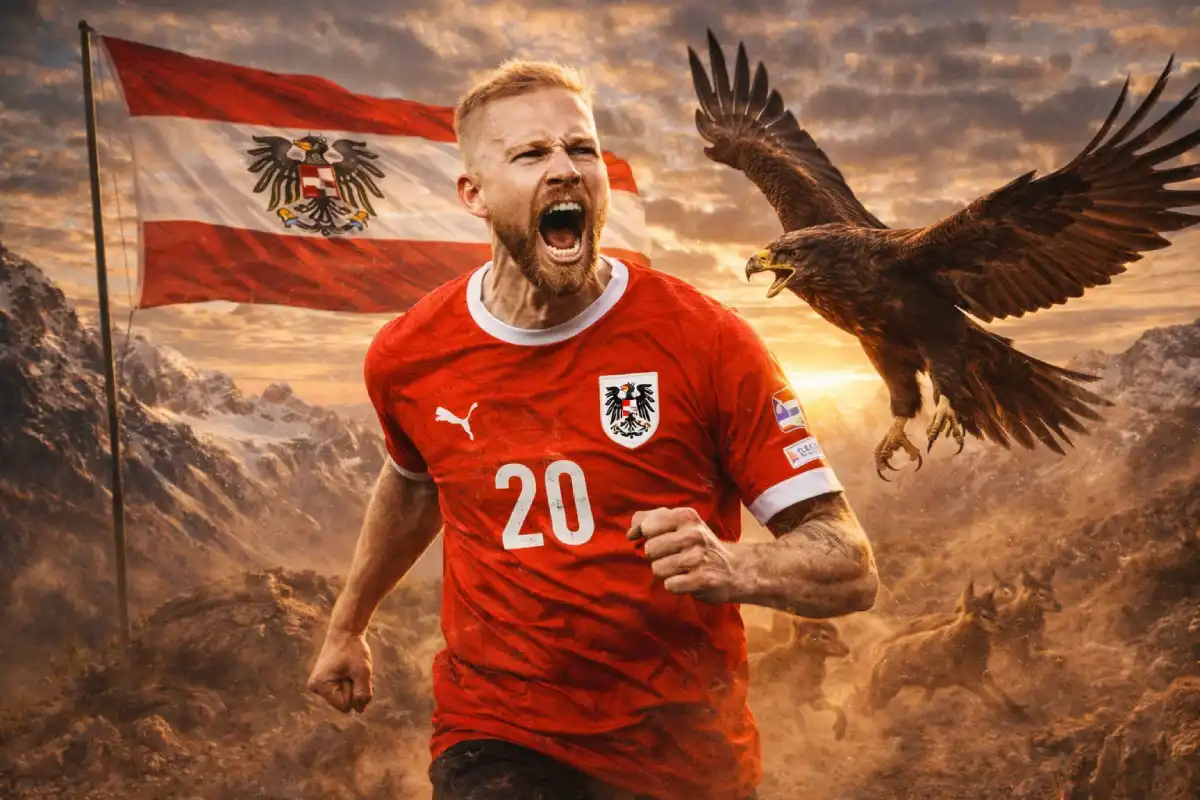
Marko Arnautovic is 37 years old at this World Cup and has absolutely no intention of being a passenger. He is Austria’s all-time record scorer, their most-capped player with over 128 appearances, and the most experienced attacker in the squad.
He now plays for Red Star Belgrade after a career that took him through Stoke City, West Ham United, Inter Milan and beyond. His physical strength, aerial ability and link-up play make him incredibly difficult to defend against. Arnautovic openly stated after the San Marino match that his one remaining ambition was to play at a World Cup. He has earned this moment more than almost anyone in Austrian football history.
David Alaba is Austria’s captain, and possibly their most famous footballer since the days of Hans Krankl. The Real Madrid centre-back turns 34 during the tournament, sharing his June 24 birthday with a certain Lionel Messi. Alaba has won over 40 major trophies in his career, including Champions League titles with both Bayern Munich and Real Madrid. His experience at the highest level is invaluable and his leadership in the dressing room sets the standard for everyone around him. This will be his first ever World Cup, something that drives him enormously.
Marcel Sabitzer is the creative engine in Austria’s midfield. The Borussia Dortmund man has evolved significantly over recent years into one of the more complete central midfielders in the Bundesliga. He controls the tempo of matches, picks intelligent passes and contributes goals too. When Austria have played their best football under Rangnick, Sabitzer is usually the player at the centre of it.
Konrad Laimer brings relentless pressing energy from his role at Bayern Munich. He covers enormous amounts of ground, wins the ball back constantly and keeps the machine running at high intensity from the first minute to the last. His UEFA Europa League Team of the Season recognition back in 2021-22 confirmed what Austrian fans already knew: this is a player operating at an elite level.
Michael Gregoritsch deserves a mention beyond just scoring the qualification clincher in Vienna. He has quietly put together a very solid international career and offers Austria a different forward option alongside Arnautovic. His ability to score decisive goals in big moments was never demonstrated more clearly than when he rifled in that equalizer against Bosnia to send his country to the World Cup.
Manager Profile: The Professor Who Built a Philosophy
Ralf Rangnick is one of the most influential football thinkers of the last 30 years. The German, who turns 68 during the tournament, practically invented the style of high-intensity pressing football that clubs like Liverpool, Manchester City and almost every modern team now use as standard practice. His nickname is “The Professor,” though he has always insisted he is more of a teacher than an academic.
Born on June 29, 1958, Rangnick built his coaching reputation across the German football pyramid before transforming TSG Hoffenheim from the sixth tier into a Bundesliga club. His two spells at Schalke produced a DFB-Pokal title and a remarkable Champions League semi-final run in 2011 where his side knocked out holders Inter Milan 7-3 on aggregate. He later shaped the entire Red Bull football network, establishing the pressing philosophy now used at Leipzig, Salzburg and clubs around the world.
His brief interim spell at Manchester United in 2021-22 raised questions about whether the hands-on coaching fire had dimmed, but his work with Austria put those doubts firmly to rest.
Appointed in 2022 to replace Franco Foda, Rangnick has now qualified Austria for consecutive major tournaments. That had never been done before in Austrian football history. He has created a squad culture built on collective effort over individual stardom, pressing all over the pitch and a clear identity that every player buys into. He has said on multiple occasions that the World Cup would be the greatest achievement of his career. That says everything you need to know about what this group of players means to him.
Tournament Expectations: Underdog With Teeth
Nobody will look at Group J and immediately pick Austria as likely group winners. Argentina are the defending world champions. Algeria qualified ahead of Nigeria and South Africa to get here. Jordan are making their World Cup debut and will be desperate to make history.
But underestimating Austria would be a serious mistake. This is the same squad that topped a Euro 2024 group containing France, the Netherlands and Poland. They know how to perform when the stakes are highest. They have tournament experience. They have quality throughout the squad. And they have a coach who prepares for opponents more thoroughly than almost anyone in the game.
The opening match against Jordan represents Austria’s clearest opportunity to start with three points and build confidence before the bigger tests arrive. The Argentina match will be the most watched game of their campaign, a genuine David and Goliath spectacle that Austrian fans will circle in their diaries. Algeria in the final group game could effectively decide who advances alongside Argentina.
Getting out of the group stage is the realistic and stated ambition. After that, in the expanded 48-team format, anything is possible for a well-organised team with quality players and a clear tactical plan.
World Cup 2026 Group Stage: The Road Ahead
Austria were drawn into Group J alongside Argentina, Algeria and Jordan. Their three group stage matches will take them from the Bay Area of California to Dallas and Kansas City. A bit of geography to master, but nothing a well-organised Austrian football federation cannot handle.
| Match | Date | Opponent | Venue | Time (ET) |
|---|---|---|---|---|
| 1 | June 17, 2026 | Jordan | Levi’s Stadium, Santa Clara, California | 12:00 AM |
| 2 | June 22, 2026 | Argentina | AT&T Stadium, Arlington, Texas | 1:00 PM |
| 3 | June 27, 2026 | Algeria | Arrowhead Stadium, Kansas City, Missouri | 10:00 PM |
The midnight kickoff against Jordan is an unusual one, though Austrian fans across Europe will be watching in the early morning hours with coffee in hand. Jordan are a motivated side making their World Cup debut and will not make it easy, but on paper this is Austria’s most winnable game. Starting the tournament with a victory would set everything up nicely.
Argentina at AT&T Stadium in Dallas is the match the whole world will be watching. Messi and Arnautovic on the same pitch, both in the likely final World Cup appearances of their legendary careers. That is the kind of storyline that writes itself. Austria will need to defend extremely well and be clinical on any chances they create. It will not be an easy afternoon, but Austria beat Italy twice in the Nations League in 2021. They are not afraid of the big occasion.
The Algeria game on June 27 could come down to a winner-takes-all situation for second place in the group. Austria will be ready for it.
Prediction
Austria will reach the Round of 32.
They will beat Jordan, lose to Argentina, and the Algeria match will be the one that decides everything. On form and quality, Austria have enough to edge that game and advance. Rangnick will have Algeria thoroughly prepared for, and his teams do not lose those types of tactical battles often.
Whether they go further in the knockout rounds depends enormously on who they face in the last 32. A kind draw could see this team push into the quarter-finals. A harsh one ends their tournament there. Either way, Austria will play attacking, high-intensity football that will win them admirers around the world and remind everyone why they were once one of the most feared teams in European football.
The 28-year wait is over. Das Team is back. And they are not just here to make up the numbers.