

For decades, Japan was the polite guest at the World Cup—technically sound, incredibly disciplined, but ultimately lacking the “killer instinct” to finish off the giants. That era ended in Qatar. In 2026, the Samurai Blue aren’t just coming to compete; they are coming to conquer the “Round of 16 Curse.”
Hajime Moriyasu’s squad arrives in North America with a roster almost entirely based in Europe’s top five leagues and a new tactical flexibility that makes them a nightmare to scout. As they prepare for the group stage, the focus is squarely on their potential path to the quarter-finals.
World Cup History: The Agony and the Evolution
Japan’s World Cup story is defined by one word: “Hekiga” (The Wall). They have reached the Round of 16 four times, and each exit has been more traumatic than the last.
- 1993: The Agony of Doha: Before they even made a World Cup, Japan missed out on USA ’94 due to a stoppage-time equalizer by Iraq. Current manager Hajime Moriyasu was on the pitch that night; he has spent his career ensuring it never happens again.
- 2018: The Rostov Counter: Leading Belgium 2-0 with 25 minutes left, Japan lost 3-2 to a 94th-minute counter-attack. It remains one of the greatest knockout games in history.
- 2022: The Penalty Drought: After topping a “Group of Death” by beating Germany and Spain, Japan fell to Croatia on penalties, missing three of four kicks.
The Road to 2026: The “Brazil Statement”
Japan became the first non-host nation to qualify for 2026, navigating the AFC qualifiers with clinical precision. But the real statement came in a friendly.
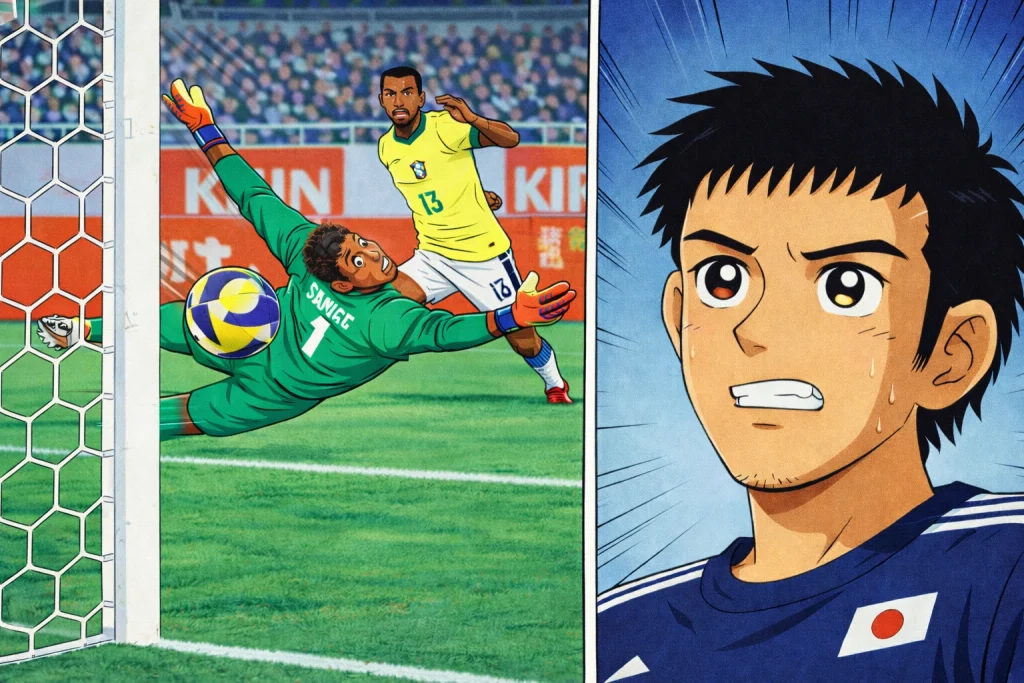
The Turning Point: In October 2025, Japan faced Brazil in Tokyo. Down 2-0 at halftime, Moriyasu unleashed an aggressive high press that shocked the Seleção. Goals from Takumi Minamino and Keito Nakamura leveled the score before Ayase Ueda thundered home a header to seal a historic 3-2 win. It proved that their 2022 upsets weren’t flukes—they can now go toe-to-toe with the world’s best when playing from behind.
Tactical Deep Dive: The “Chameleon” Block
Hajime Moriyasu is often criticized by domestic media for being conservative, but his “Chameleon” tactics are exactly why Japan is so dangerous in tournament football.
- The Shape: Japan typically starts in a 4-2-3-1 but will pivot to a 5-4-1 mid-game to protect a lead.
- The “Small-Fast-Agile” Doctrine: Unlike European teams that rely on physicality, Japan uses rapid, one-touch passing patterns to exploit the “half-spaces.” They don’t try to out-muscle you; they try to out-think you.
- The Matchup Advantage: This transition speed is the specific kryptonite for the high defensive line detailed in our Netherlands World Cup 2026 Team Profile. While the Dutch want to compress the pitch, Japan wants to expand it, using Mitoma and Kubo to attack the space behind Van Dijk.
Fan Culture: “Blue Lock” and the Clean-Up Crew
The Japan “vibe” is a unique blend of traditional respect and modern pop culture. The “Clean-Up Crew”—fans staying behind to clean the stadium after matches—will be a viral sensation again in 2026.
However, on the pitch, the fans have embraced the “Blue Lock” narrative (based on the popular anime). They no longer want “team players”; they want a pure “egoist” striker who demands the ball and scores the ugly goals. In Ayase Ueda, they believe they have finally found him.
Key Players: The Samurai Leaders
The 2026 squad is the deepest in Japanese history. Here is how the key figures stack up based on their 2025/26 club form.
The Captain: Wataru Endo (Liverpool)
Role: The “Duel King.” He is the tactical brain who shields the defense and organizes the press.
- 2025/26 Form: A rotation option for Liverpool, but fresh for the World Cup. His pass completion rate remains elite (91%).
- Fan Pulse: “The most important player. When Endo plays, Japan doesn’t break.”
The Star: Takefusa Kubo (Real Sociedad)
Role: The creative hub. Operating from the right wing, his tight-space dribbling is the team’s primary weapon against low blocks.
- 2025/26 Form: 8 Goals, 12 Assists in La Liga. Heavily linked with a summer move to Tottenham.
- Fan Pulse: “Finally living up to the hype. He’s the player that makes European scouts stay up late.”
The Finisher: Ayase Ueda (Feyenoord)
Role: The clinical #9. Unlike previous Japanese strikers who focused on link-up play, Ueda is a pure goal-hunter.
- 2025/26 Form: 18 Goals in the Eredivisie. Currently challenging for the Golden Boot in the Netherlands.
- Fan Pulse: “The striker we’ve waited 20 years for. He doesn’t care about ‘Total Football,’ he just cares about the net.”
The X-Factor: Kaoru Mitoma (Brighton)
Role: The 1v1 master. Mitoma’s ability to drive at defenders is world-class, but his fitness is the biggest question mark.
- 2025/26 Form: Missed 3 months with an ankle injury but returned in March 2026. If he is 100%, he starts; if not, he is the world’s most dangerous super-sub.
- Fan Pulse: “We are praying for his ankle. Without him, we lose our spark.”
World Cup 2026 Group Stage: Group F
| Match | Date | Opponent | Venue | Time (ET) |
|---|---|---|---|---|
| 1 | June 14, 2026 | Netherlands | AT&T Stadium, Dallas | 4:00 PM |
| 2 | June 21, 2026 | Tunisia | Estadio Monterrey, Mexico | 5:00 PM |
| 3 | June 25, 2026 | UEFA Playoff B Winner | AT&T Stadium, Dallas | 7:00 PM |
World Cup 2026 Outlook: The Verdict
Japan enters 2026 with the most talented squad in their history, but their path is brutal. The opener against the Netherlands will determine if they are fighting for 1st or 2nd.
Success Definition: Breaking the “Round of 16 Curse.” A Quarter-Final appearance is the only result that will satisfy this generation. They have the speed to hurt the Dutch, but the real test of their maturity will be breaking down the defensive “Dark Arts” detailed in our Tunisia World Cup 2026 Team Profile. If they can solve that puzzle in Monterrey, the Samurai Blue aren’t just a dark horse—they are a legitimate contender to go deep.


